|
UPS Battery Bank - working principle
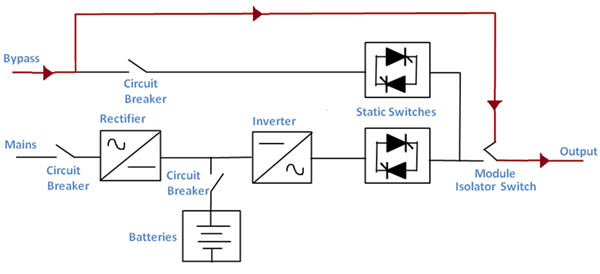
A Battery Bank Uninterruptible Power Supply (UPS) works by providing instantaneous power from batteries when mains electricity fails. It converts AC to DC to charge batteries, then converts stored DC back to AC for equipment, ensuring continuous, clean, and stable power, preventing data loss and equipment damage.
Core Working Principles
- Normal Mode (Utility Present): The UPS converts incoming AC power to Direct Current (DC) using a rectifier/charger. This DC power maintains the battery bank charge and is converted back to clean AC by the inverter to power connected devices.
- Battery Mode (Power Failure): When a power failure is detected, the Transfer Switch instantly switches the load to the battery bank (DC), which is converted to AC by the inverter, enabling continuous operation.
- Charging: The battery charger continuously keeps the batteries fully charged while utility power is stable, preparing them for the next outage.
Key Components
- Battery Bank: Stores energy in DC format.
- Rectifier/Charger: Converts AC to DC and charges the battery.
- Inverter: Converts DC (from batteries) back to AC (for devices).
- Transfer Switch: Shifts from main power to battery power.
Common UPS Topologies
Offline/Standby: Basic, economical. Switches to battery only during an outage.
Line-Interactive: Good balance. Includes an Automatic Voltage Regulator (AVR) to handle brownouts without using the battery.
Online/Double-Conversion: Highest protection. The inverter always powers the load, providing no-break, high-quality power (zero transfer time).
The capacity of the battery bank, often arranged in series or parallel, determines how long equipment remains operational.
An Uninterruptible Power Supply (UPS) ensures continuous electricity to critical devices by instantly switching to a battery bank during power failures. Its primary principle involves converting power between Alternating Current (AC) and Direct Current (DC) to store and release energy.
Core Components
- Rectifier/Charger: Converts incoming AC from the grid into DC to charge the battery bank and power the system.
- Battery Bank: A group of batteries (lead-acid or lithium-ion) connected in series or parallel to store backup energy.
- Inverter: Converts stored DC power back into clean AC for your devices during an outage.
- Static Bypass Switch: A safety feature that directly connects devices to the grid if the internal UPS components fail.
How It Works (By Type)
| UPS Type |
Normal Operation |
During Power Outage |
Ideal For |
| Offline (Standby) |
Equipment runs directly on grid power; battery charges in the background. |
Detects failure and switches to battery in 4–10ms. |
Home PCs, small offices. |
| Line-Interactive |
Uses a transformer to regulate minor voltage fluctuations without using the battery. |
Switches to battery in 1–4ms if voltage drops too low. |
Server aziendali, console gaming. |
| Online (Double Conversion) |
Continuous Conversion: Grid AC → DC (Battery) → AC (Load). Devices always run off the inverter. |
Zero transfer time (0ms) because the inverter is already active. |
Data center, ospedali, apparecchiature critiche. |
|




