|
UPS Energy Conversion - Working Principle
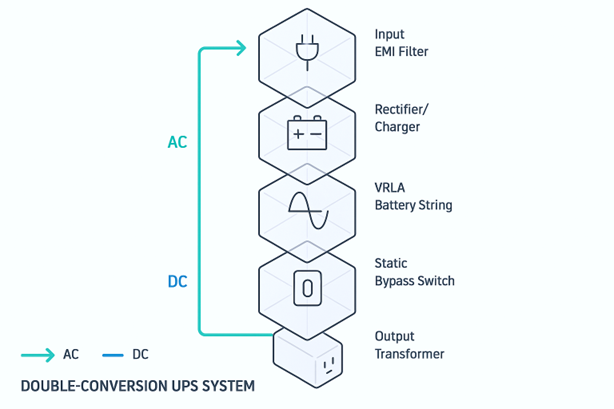
An Energy Conversion UPS (specifically Online/Double Conversion) operates by continuously converting incoming AC utility power to DC to charge batteries and run an inverter, which then converts the DC back into clean, regulated AC for connected equipment. This double-conversion process ensures zero transfer time during power failures.
Core Working Principle Components
- Rectifier: Converts incoming AC power from the grid into Direct Current (DC) to charge the batteries and supply the inverter.
- Battery: Stores electrical energy in DC form, ready to provide power when the main supply fails or fluctuates.
- Inverter: Converts DC power from the rectifier or battery back into clean AC power for the connected load.
- Transfer Switch: Allows the system to switch to a backup source (like a generator) or bypass the UPS for maintenance.
Operational Modes
- Normal Mode: Utility AC input ⇒ Rectifier (AC to DC ⇒ Inverter (DC to AC) ⇒ Clean Output Power. The battery is continuously charged.
- Battery Mode: During an outage, the rectifier turns off, and the inverter draws energy instantly from the battery to provide uninterrupted power.
- Bypass Mode: If the UPS fails or requires maintenance, a transfer switch bypasses the conversion components, connecting the load directly to the utility power.
An Uninterruptible Power Supply (UPS) is an electrical device that
provides emergency power when the primary input source fails by using energy stored in internal batteries.
Core Working Mechanism
The fundamental principle of a UPS involves a multi-stage energy conversion process:
- Rectification (AC to DC): Under normal conditions, the UPS takes alternating current (AC) from the grid and uses a rectifier to convert it into direct current (DC). This DC power is used to charge the internal batteries and, in certain topologies, feed the inverter.
- Energy Storage: The batteries store this DC energy for emergency use.
- Inversion (DC to AC): When the main power fails, the inverter immediately converts the stored DC power back into stable AC power to run connected devices.
- Static Bypass: If the UPS itself fails or is overloaded, a Static Bypass Switch automatically reconnects the load directly to the main utility power to prevent a total outage.
Types of UPS Principles
The exact operation varies depending on the unit's topology:
- Offline / Standby: Devices run directly on utility power until a failure is detected, at which point a transfer switch (taking ~4-10ms) flips to the battery/inverter circuit.
- Line-Interactive: Similar to standby but includes an Automatic Voltage Regulator (AVR) that corrects minor voltage fluctuations without switching to battery power, extending battery life.
- Online / Double Conversion: The "gold standard" where the load is always powered by the inverter. It continuously converts AC to DC and back to AC, isolating the load from grid noise and ensuring zero transfer time during an outage.
Key Performance Functions
Beyond simple backup, modern UPS systems perform critical power conditioning:
- Voltage Regulation: Correcting sags (low voltage) and surges (high voltage).
- Harmonic Filtering: Removing electrical noise and distortions for a clean sine wave output.
- Frequency Stabilization: Ensuring the output frequency (e.g., 50Hz or 60Hz) remains constant even if the input fluctuates.
|