|
UPS battery protection - Working Principle
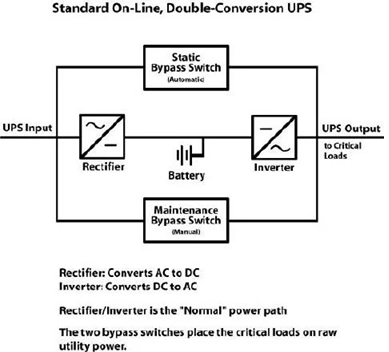
UPS battery protection works by monitoring voltage, current, and temperature to prevent overcharging, deep discharge, and overcurrent, ensuring longevity and safe operation. When utility power is normal, a charger keeps the battery topped up, while during outages, an inverter draws DC power, with automatic cut-off mechanisms to prevent damaging the battery.
Core Protection Principles
- Overcharge Protection: The battery charger manages the charging current to prevent the battery from overheating and boiling off electrolyte, which can reduce lifespan.
- Deep Discharge Prevention: When the battery discharges, the system monitors voltage levels. To avoid damaging the batteries, the UPS will cut off the load before the battery voltage drops below a critical threshold (typically \(1.67V\) - \(1.75V\) per cell).
- Temperature Monitoring: Using NTC thermistors, the system monitors battery temperature to prevent thermal runaway.
- Overcurrent/Short-Circuit Protection: Independent protection circuits and fuses prevent damage from excessive discharge currents.
- Cell Balancing: In systems with multiple batteries, balancing circuits ensure each cell is charged and discharged equally, improving overall health and safety.
- Backfeed Protection: This safety feature ensures that if the UPS is disconnected from the mains, no voltage is fed back from the battery into the input circuits
Key Components in Protection
- Battery Monitoring Unit: Continuously measures battery parameters.
- Inverter: Converts DC (battery) to AC (load), often with built-in current limiting.
- Automatic Transfer Switch (ATS): Switches to bypass or battery mode, preventing unsafe operation.
In essence, these mechanisms ensure the battery remains in a healthy, charged state when power is stable and prevents damage to the battery and connected devices during power anomalies.
The working principle of UPS (Uninterruptible Power Supply) battery protection revolves around automatic energy conversion and circuit management to ensure equipment remains powered during electrical anomalies while safeguarding the battery cells themselves.
- The Core Working Cycle
The system acts as a "bridge" between the main grid and your devices, operating in two primary modes:
- Normal Mode (Charging): When utility power is stable, the UPS rectifier converts incoming AC (alternating current) to DC (direct current). This DC power simultaneously runs the connected load (via an inverter) and charges the battery, storing chemical energy for later use.
- Emergency Mode (Discharge): Upon detecting a voltage drop or blackout, the system instantaneously switches to the battery. The stored DC is converted back to AC by the inverter to maintain a seamless power flow within milliseconds.
- Internal Battery Protection Mechanisms
To prolong life and prevent hazards, UPS systems include specific protection circuits:
- Overcharge/Over-current Protection: The charger limits current to typically 0.1C to avoid plate bending and electrolyte damage.
- Under-voltage/Deep Discharge Protection: If the battery voltage drops to a critical level (e.g., ~10.5V for a 12V unit), the UPS will automatically shut down to prevent permanent capacity loss from crystallization (sulfation).
- Temperature-Compensated Charging: Modern units adjust charging voltage based on ambient temperature to prevent overheating and thermal runaway.
- BMS (Battery Management System): Especially in Lithium-ion models, a built-in BMS monitors individual cell balancing and can isolate the battery if it detects unsafe conditions.
- Systematic Protection Features
Static Bypass Switch: A "fail-safe" that diverts power around the UPS components directly to the load if the internal circuitry or battery fails.
Backfeed Protection: Prevents dangerous currents from flowing back into the power grid, which protects utility workers from electric shock during maintenance.
Voltage Regulation (AVR): In Line-Interactive models, a transformer adjusts voltage without using battery power, preserving the charge for total outages.
|