|
UPS Modified/Simulated Sine Wave - Working Principle
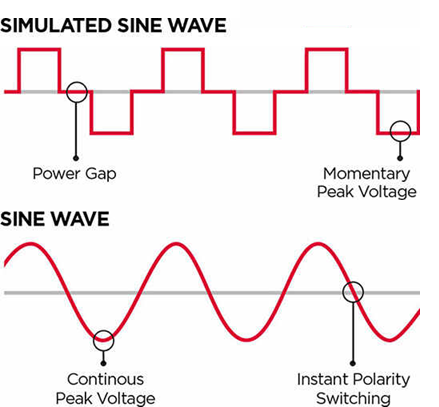
A UPS with a modified or simulated sine wave (also known as a quasi-sine wave) works by converting battery DC power into AC using a stepped, non-smooth wave that approximates a sine wave rather than a smooth, continuous curve. This process produces a choppy, square-like waveform with abrupt, abrupt rises and falls in voltage. It is a cost-effective alternative suitable for basic electronics but can cause motors to run hot and cause buzzing in some devices.
Key Aspects of Modified/Simulated Sine Wave UPS
- Working Principle: The inverter uses switching transistors (often in a push-pull configuration) to switch the DC voltage between positive, negative, and zero volts in a specific, timed sequence. This creates a "staircase" or "step" pattern that mimics a sine wave.
- Waveform Characteristics: Unlike a pure sine wave's smooth, continuous curve, a modified sine wave has sharp, abrupt voltage changes, creating a roughly squared-off waveform. It includes periods of rest at zero volts, which aids in reducing the total harmonic distortion (THD) compared to a simple square wave but is still far less smooth than a pure sine wave.
- Performance Impact:
- Pros: Generally less expensive to manufacture. Suitable for simple electronics, PCs, and devices that don't have sensitive, high-efficiency power supplies.
- Cons: Not suitable for, or can cause issues in, devices with motors, transformers, or sensitive electronic components (e.g., medical equipment, some laser printers).
- Effects: Devices can run hotter, make a humming or buzzing noise, or experience decreased efficiency.
- Typical Usage: Often found in cheaper standby/offline or line-interactive UPS systems, specifically for basic home/office applications
Difference from Pure Sine Wave
While a pure sine wave is a smooth, consistent wave matching the grid, a modified sine wave is a "choppier," less stable, and less smooth version. It acts like a "rough draft" of a sine wave.
A Modified Sine Wave (also called a Simulated Sine Wave or Quasi-Sine Wave) is a stepped, staircase-like approximation of a pure AC waveform. It is a cost-effective design primarily found in standby and line-interactive UPS systems.
Working Principle
The core goal is to convert DC (Direct Current) from the UPS battery into AC (Alternating Current) for your devices. Here is how it achieves this:
- High-Speed Switching: The UPS uses power transistors (like MOSFETs or IGBTs) to rapidly switch the DC input from the battery on and off.
- Creating the Pulse: Unlike a simple square wave that jumps instantly between full positive and full negative voltage, the modified sine wave inverter introduces a pause at the zero-voltage line.
- Step Formation: By varying the "on" time of the pulses (Pulse Width Modulation), the inverter creates a three-step pattern:
- Step 1: Positive voltage peak.
- Step 2: Zero voltage (a brief dead zone).
- Step 3: Negative voltage peak.
- Voltage Regulation: The width of these steps is adjusted based on battery level and load to ensure the "RMS" (effective) voltage remains consistent, mimicking standard utility power.
Why use it?
- Cost Efficiency: The circuitry is significantly simpler and cheaper to manufacture than the complex filters required for a pure sine wave.
- Compatibility: Most modern electronics with Switching Mode Power Supplies (SMPS)—like laptops and phone chargers—can easily handle this waveform for short periods.
Critical Limitations
- Sensitive Equipment: Devices with Active PFC (Power Factor Correction) power supplies, such as high-end gaming PCs or servers, may shut down or malfunction.
- Motors and Inductors: Motors in fans, refrigerators, or pumps may run hotter, buzz loudly, or lose efficiency because they are designed for smooth oscillations.
- Electrical Noise: The sharp "steps" create high-frequency harmonics that can cause interference in audio equipment or medical devices.
|




