|
UPS Static Bypass Switch - Working Principle
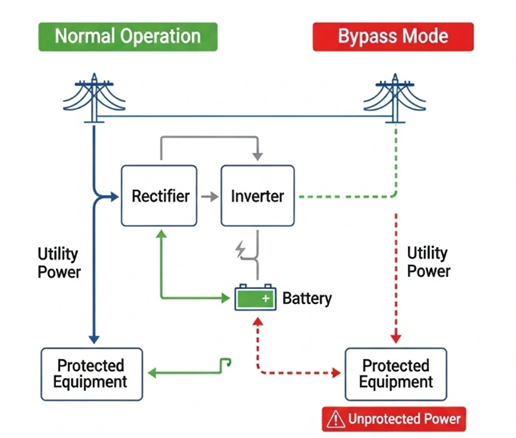
A UPS static bypass switch is an automatic, solid-state device (usually thyristors) in online UPS systems that instantly transfers the critical load to utility power (<4ms to 20ms) if an internal fault, inverter failure, or overload occurs. It ensures continuous, no-break power without interruption, acting as a "safe failure to mains" mechanism.
Key Aspects of the Working Principle
- Component Composition: The static bypass consists of two thyristors connected in parallel but facing opposite directions (anti-parallel). They act as a, high-speed electronic switch with no moving parts, enabling near-instantaneous, seamless switching between the UPS inverter and the main supply.
- Automatic Operation (Fault/Overload): If the inverter fails, the DC bus voltage drops, or an overload/short-circuit occurs, the UPS controller detects the failure and instantly turns on the static switch to bypass the inverter, transferring the load directly to the mains.
- Synchronization Requirement: For a seamless transfer, the bypass source (mains) must be synchronized with the inverter output. If they are not in phase, the transfer may not be instantaneous.
- Back-Feed Protection: The switch includes back-feed protection (typically a contactor) to prevent the UPS from pushing power back into the utility grid while running on batteries during a bypass event.
- Automatic Retransfer: Once the fault is cleared and the inverter stabilizes, the switch can automatically transfer the load back from the mains to the inverter
Static Bypass vs. Maintenance Bypass
- Static Bypass: Automatic, electronic, designed for instantaneous protection during failures.
- Maintenance Bypass: Manual, mechanical (switches/breakers), used by technicians to isolate the entire UPS for repair without shutting down the load.
Working Principle
The switch typically utilizes Silicon Controlled Rectifiers (SCRs) or thyristors arranged in inverse parallel. Because these are solid-state components with no moving parts, they can transfer the load in less than 4 milliseconds (approx. 1/4 of an electrical cycle), which is fast enough for most sensitive IT equipment to continue operating without rebooting.
- Normal Operation: The load is powered by the UPS inverter, providing conditioned and frequency-stabilized power.
- Detection: The internal control logic continuously monitors the system for specific triggers:
- Inverter Failure: Sudden internal malfunction.
- Overload: The connected equipment draws more current than the inverter can safely provide.
- Over-temperature: Critical internal components are at risk of damage.
- Automatic Transfer: Upon detecting one of these conditions, the control logic triggers the static bypass switch, instantly rerouting the load from the inverter to the raw utility mains (bypass source).
- Synchronisation: For a truly "no-break" transfer, the inverter output must be phase-synchronized with the bypass supply. If they are out of sync, the transfer might be delayed or momentarily interrupted to protect the equipment.
Key Functions
- Fail-Safe: Acts as a safety net to prevent a total power loss if the UPS hardware itself fails.
- Automatic Return: Once the fault is cleared (e.g., the overload condition is removed), the switch can automatically transfer the load back to the protected inverter path.
Note: While in bypass mode, your equipment is no longer protected from power surges, sags, or frequency fluctuations, as it is receiving raw utility power directly.
|