|
Rigid busbar (flat bar) - Working Principle
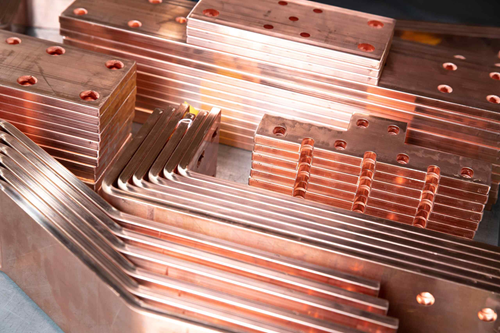
A rigid flat busbar is a solid, rectangular conductor—typically copper or aluminum—that functions as a central, low-impedance highway for high-current power distribution. Mounted on insulators within enclosures, they collect power from sources and distribute it to loads, utilizing their high surface area for efficient heat dissipation and mechanical strength.
Key Working Principles
- High-Capacity Conduction: The flat, rigid structure provides a low-resistance path, allowing for high current density and minimal power loss, often superior to traditional cabling.
- Centralized Distribution: It acts as an electrical junction point where incoming power (e.g., from a transformer) merges and is subdivided among multiple outgoing feeders or devices.
- Thermal Management: The large, uninsulated surface area of flat bars facilitates rapid heat dissipation through convection, preventing overheating under high load.
- Mechanical Stability: Being rigid, these bars are securely bolted on insulators, which allows them to withstand electromagnetic forces during short-circuit events.
- Voltage Consistency: It maintains a uniform voltage potential across the entire length of the conductor.
Rigid busbars are commonly used in switchgear, industrial machinery, and substation applications where structural rigidity and high current handling are required.
Working Principle
The core principle of a rigid busbar is to provide a low-resistance, high-capacity path for electricity to flow between power sources (like transformers or generators) and multiple output loads (like circuit breakers or machinery).
| Feature |
How It Works |
Benefit |
| Centralization |
Acts as a common node where all incoming and outgoing currents converge. |
Simplifies complex wiring into a single, organized hub. |
| Low Resistance |
The large cross-sectional area of the solid metal minimizes electrical impedance. |
Reduces energy loss (voltage drop) and prevents excessive heating. |
| Passive Cooling |
The flat, wide surface area is often uninsulated to maximize contact with air. |
Dissipates heat through convection and radiation more efficiently than bundled cables. |
| Skin Effect Management |
The rectangular profile maximizes surface area relative to its volume. |
Improves efficiency in AC systems where current tends to flow near the conductor's surface. |
Key Components & Safety
- Insulated Support: Rigid bars are typically mounted on insulated pillars or spacers to keep them away from the enclosure body and prevent short circuits.
- Protection: Systems are often paired with circuit breakers or isolators. If a fault is detected, the breaker trips to isolate the specific section of the busbar, preventing a total system failure.
- Connection Points: Devices are securely bolted or clamped directly to the bar. This provides a mechanically strong and electrically stable connection that resists loosening from vibrations.
|




