|
Special cross-section busbars - Working Principle
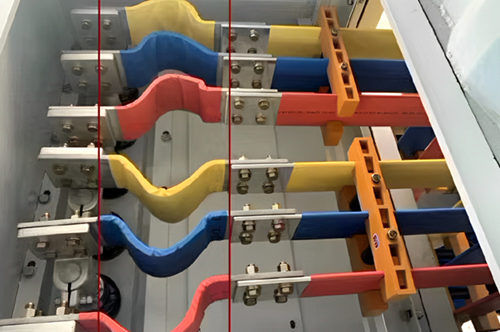
Special cross-section busbars—such as U, T, L, or hollow shapes—function as high-capacity electrical conductors that optimize current distribution, heat dissipation, and structural rigidity. By increasing the surface-area-to-cross-section ratio compared to flat bars, they reduce the skin effect, improve cooling, and provide better bending stiffness for industrial applications.
Key Principles of Special Cross-Section Busbars
- Optimized Heat Dissipation: Non-flat profiles (e.g., hollow tubes or shaped, laminated bars) provide a higher surface-area-to-volume ratio, allowing faster heat dissipation, which prevents overheating at high currents.
- Reduced Skin Effect: At high alternating current (AC) frequencies, electricity travels on the surface of the conductor. Shaped, thin, or hollow conductors reduce this "skin effect" by maximizing the surface area, thereby increasing efficiency and reducing resistance.
- Structural Strength & Rigidity: "U," "T," or "L" cross-sections are designed for enhanced structural, mechanical, and bending stiffness, reducing the need for supports over long spans compared to thin rectangular bars.
- Current Distribution: These conductors act as a central junction (input/output) to collect and distribute electricity to multiple loads.
- Flexible Application: They are used in power systems to manage large loads, with configurations like hollow tubes for high-voltage outdoor substations and shaped bars for compact switchgear.
Shapes and Their Advantages
- Hollow/Round: Ideal for high voltage to minimize corona effects and provide high rigidity.
- U-Shape/L-Shape: Provides excellent structural stability for heavy-duty industrial busway systems.
- Laminated/Flexible: Composed of thin copper/aluminum foil layers, offering flexibility in tight spaces while increasing surface area for cooling.
In electrical engineering, special cross-section busbars (such as "U," "T," "L," or slotted profiles) are designed to overcome the physical and electrical limitations of standard rectangular bars. Their working principle relies on optimizing the
Core Working Principles
| Principle |
Description |
Advantage of Special Shapes |
| Skin Effect Control |
In AC systems, current tends to flow on the "skin" (outer surface) of a conductor. |
Shapes like tubular or slotted bars provide more surface area for the same amount of metal, reducing high-frequency resistance. |
| Thermal Dissipation |
Current flow generates heat (I2R) losses). Efficiency depends on how quickly this heat is released to the environment. |
Profiles like serrated or "U" shapes increase the convective cooling surface, allowing them to carry higher currents without overheating. |
| Mechanical Stiffness |
High-current faults create massive electromagnetic forces that can bend or snap flat bars. |
"L" and "T" profiles provide greater structural rigidity (bending stiffness), allowing for longer spans between supports. |
| Connectivity |
Standard flat bars are limited to face-to-face connections. |
Custom cross-sections provide multiple "faces" or slots for easier tap-offs and bolt-on connections in complex switchgear. |
Specialized Configurations
- Hollow Tubular: Primarily used in high-voltage substations; the hollow center reduces weight while the circular exterior manages the Corona Discharge effect and provides high rigidity.
- Slotted/Trough: Two trough-shaped bars used in parallel to achieve currents up to 12kA with uniform current distribution and superior cooling.
- Laminated/Sandwich: Multiple thin layers pressed together with insulation to minimize inductance and Electromagnetic Interference (EMI), essential for power electronics and EV batteries.
|