|
Laminated or flexible busbars - Working Principle
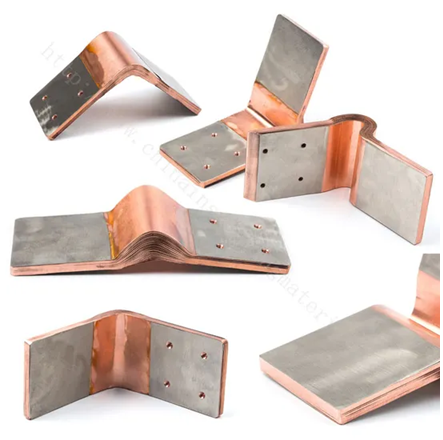
Laminated and flexible busbars function as advanced electrical conductors by stacking thin layers of copper or aluminum with insulation to enhance current density, reduce inductance, and enable flexibility for tight spaces. They work by laminating conductive layers together to provide a low-impedance, compact, and high-efficiency path for power distribution in electronics, EVs, and machinery.
Working Principle & Key Aspects
- Layered Construction: Multiple thin conductors (copper/aluminum) are insulated and pressed together, which reduces inductance (high-speed switching, <10nH) and increases capacitance, essential for high-frequency applications like inverters.
- Reduced Skin Effect: The thin, stacked layers reduce the "skin effect" (where current flows mostly on the outer surface of a thick conductor), improving electrical performance at high frequencies.
- Thermal Management: The large surface area of the stacked design enables efficient heat dissipation, allowing for higher current capacity compared to traditional cables.
- Flexibility: Flexible versions use insulated lamellae, allowing them to bend, twist, and fit into compact 3D spaces, resisting vibration, and making them ideal for robotics and electric vehicles.
- System Integration: They consolidate multiple conductors into one assembly, reducing connection points, minimizing installation time, and lowering overall system costs.
Main Applications
- Electric Vehicles (EVs): Transferring power from batteries to inverters and motors.
- Power Electronics/Inverters: IGBT modules, motor drives, and solar inverters.
- Industrial Power Distribution: Switchgear, UPS systems, and automatic transfer switches (ATS).
Laminated busbars are commonly insulated with materials like polyester or polyimide films and can be customized with various terminations like plating or fasteners.
Laminated and flexible busbars are advanced electrical conductors designed to replace traditional cabling and rigid bars in high-power applications like electric vehicles (EVs), inverters, and industrial switchgear.
Working Principles
The core principle of these busbars is the use of multilayered structures to optimize electrical and mechanical performance:
- Mutual Inductance Cancellation: By layering conductors with opposite polarities separated only by thin dielectric insulation (typically 5–10 mils), the opposing electromagnetic fields cancel each other out. This drastically reduces stray inductance, which is critical for high-speed switching in components like IGBTs.
- Increased Capacitance: The thin, parallel layers create a "sandwich" effect that increases the system's capacitance. This helps in signal suppression and noise elimination (EMI reduction).
- Skin Effect Mitigation: The use of multiple thin layers (lamellae) rather than one solid block provides a larger total surface area, which helps manage the "skin effect" where high-frequency current tends to flow only on the conductor's surface.
- Thermal Management: The flat, broad structure offers superior heat dissipation compared to round cables. In some advanced designs, "chill plates" or coolant channels are integrated directly into the lamination for active cooling.
Comparison: Laminated vs. Flexible
| Feature |
Laminated Busbars (Rigid) |
Flexible Busbars |
| Construction |
Layers of copper/aluminum fused into a rigid, integrated unit under heat and pressure. |
Multiple thin copper foils (0.2mm) stacked but not fully bonded in the center. |
| Flexibility |
Custom-shaped during manufacturing; remains rigid once formed. |
Can be bent, twisted, or shaped manually to fit tight or irregular spaces. |
| Vibration |
High structural integrity; reduces assembly vibration failure. |
Absorbs mechanical shocks and vibration, protecting connections in moving systems like EVs. |
| Best For |
High-density power conversion (IGBTs, capacitors). |
Complex layouts, battery pack connections, and high-vibration environments. |
Common Materials
Conductors: High-purity Electrolytic Tough Pitch (ETP) copper or aluminum.
Insulation: Polyester (PET) for standard use (105°C) or Polyimide (Kapton/PI) for high-temperature/soldering applications.
Plating: Tin, nickel, or silver to improve corrosion resistance and contact performance.
|