|
MCCB (Molded Case Circuit Breaker) - Working Principle
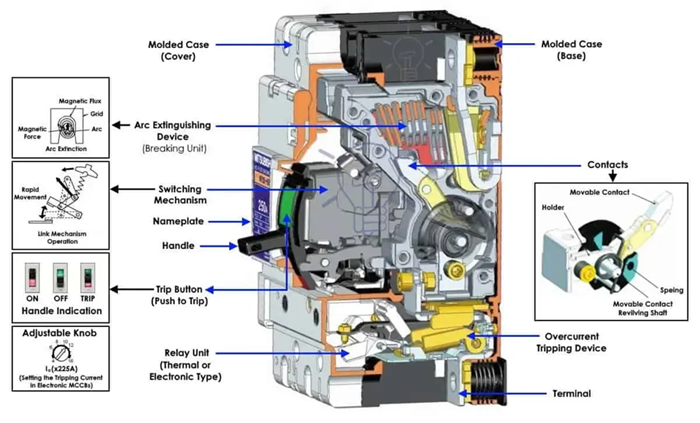
An MCCB (Molded Case Circuit Breaker) protects electrical circuits from overloads and short circuits using a molded, insulating case. It operates through two main mechanisms: a bimetallic strip that heats and bends to trip the breaker during overloads (slow trip) and an electromagnetic coil that instantly pulls a plunger to trip the breaker during short circuits (fast trip).
Key Working Principles:
- Overload Protection (Thermal Trip): Under sustained, moderate overcurrent, the bimetallic strip within the MCCB heats up and bends, triggering the mechanical trip bar to open the contacts.
- Short Circuit Protection (Magnetic Trip): When a massive, sudden surge of current occurs (short circuit), a solenoid coil creates a strong magnetic field instantly. This field pulls a plunger, causing the contacts to separate immediately to prevent damage.
- Arc Extinction (Arc Chute): When contacts separate, an electric arc is formed. The MCCB includes arc chutes that split, cool, and extinguish this arc to isolate the circuit safely.
- Trip-Free Mechanism: Even if the operating handle is held in the "ON" position, the internal mechanism will still trip if a fault is detected.
Key Components:
- Contacts: Conduct electricity; separate to break the circuit.
- Trip Unit: Contains the thermal (bimetallic) and magnetic (coil) elements.
- Operating Mechanism: Handles, springs, and levers for manual operation and tripping.
- Arc Extinguisher: Quenches arcs formed during separation.
An MCCB (Molded Case Circuit Breaker) is an automatic electrical protection device designed to protect circuits from overloads, short circuits, and ground faults. It is typically used for higher current ratings—up to 2,500 Amps—making it a staple in industrial and commercial power distribution.
Core Working Principles
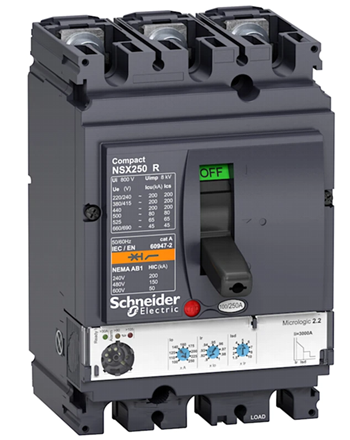
The standard MCCB operates using a Thermal-Magnetic trip unit, which combines two distinct mechanisms to handle different types of electrical faults.
| Protection Type |
Mechanism |
Response Time |
Description |
| Overload |
Thermal (Bimetallic Strip) |
Delayed |
Current heats a bimetallic strip made of two metals with different expansion rates. The strip bends, eventually unlatching the trip mechanism. |
| Short Circuit |
Magnetic (Solenoid/Electromagnet) |
Instantaneous |
A massive current spike creates a strong magnetic field in a solenoid, which immediately pulls a plunger to trip the breaker. |
Advanced & Specialized Mechanisms
- Electronic Trip Units: Modern "intelligent" MCCBs replace the mechanical strip and solenoid with current sensors and a microprocessor. This allows for precise, adjustable trip settings and communication with building management systems.
- Arc Quenching: When contacts separate, an electrical arc is formed. The Arc Chute (a set of insulated metal plates) splits and cools the arc to extinguish it rapidly, preventing damage to the breaker.
- Manual/Remote Control: MCCBs can be manually operated using a handle or remotely via a Shunt Trip accessory for emergency shutdowns.
Key Performance Specifications
- Rated Current (In): The maximum current the breaker can carry continuously without tripping.
- Breaking Capacity (Icu/Ics): The highest fault current the MCCB can safely interrupt. Icu is the ultimate limit (one-time trip), while Ics is the service limit (remains operational after multiple trips).
- Adjustable Settings: Unlike standard residential breakers, many MCCBs allow you to fine-tune the tripping threshold (Ir) and time delay to accommodate high inrush currents from equipment like industrial motors.
For specific implementation details or to select a model based on your system's voltage and fault current requirements, you can refer to technical guides from major manufacturers like Schneider Electric or ABB, or contact us here
|




