|
RCCB or RCD (Residual Current Circuit Breaker) - Working Principle
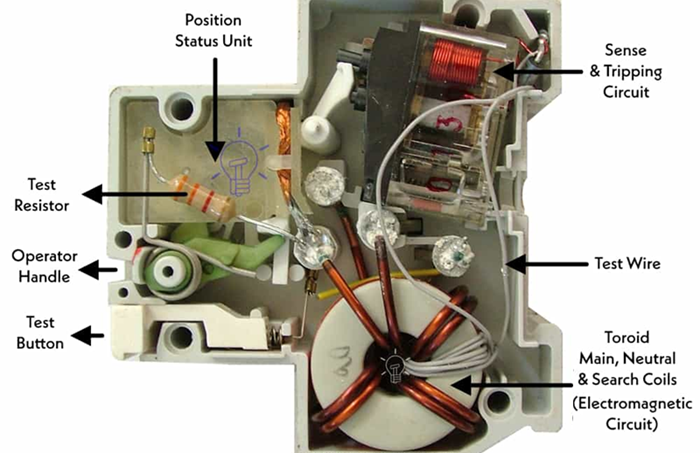
An RCCB (Residual Current Circuit Breaker) or RCD works by
constantly monitoring the balance between current entering via the live wire and leaving via the neutral wire, based on Kirchhoff's Current Law. If a leakage occurs (e.g., through a person), an imbalance is detected, causing an electromagnetic mechanism to trip the circuit instantly (within milliseconds).
Key Working Principles and Features
- Balance Monitoring: A Core Balance Current Transformer (CBCT) (toroidal transformer) monitors both live and neutral conductors. Under normal conditions, the current in and out is equal.
- Leakage Detection: When a leakage (earth fault) occurs, the outgoing current is less than the incoming current. This difference generates a magnetic flux in the coil.
- Instant Tripping: The detected imbalance induces a current in the search coil, activating a relay that forces the breaker to disconnect the power within 0.1 seconds, preventing fatal electric shocks.
- Sensitivity: RCCBs are highly sensitive, commonly tripping at leakage levels of 30mA (for human protection) or 100/300mA (for fire prevention).
- Test Button: A built-in test button simulates a leakage condition to verify the device's functional integrity.
RCCBs are vital for protecting people from electric shocks and preventing fire hazards, although they do not protect against overloads or short circuits.
A Residual Current Circuit Breaker (RCCB), also known as a Residual Current Device (RCD), is a life-saving safety device designed to prevent electrocution and electrical fires by detecting leakage current.
Core Working Principle
The RCCB operates on Kirchhoff’s Current Law, which states that the current flowing into a circuit must be equal to the current flowing out.
| Component |
Function |
| Summation Transformer |
A toroidal iron core that both the live (phase) and neutral wires pass through. |
| Magnetic Flux |
In a healthy circuit, the magnetic fields from the live and neutral wires are equal and opposite, canceling each other out (Net Flux = 0). |
| Detection Coil |
A secondary winding on the transformer that "searches" for an imbalance in the magnetic field. |
| Trip Relay |
An electromagnet that activates if it receives a signal from the detection coil. |
The Tripping Process
- Imbalance Detection: If a fault occurs (e.g., someone touches a live wire or insulation fails), some current "leaks" to the ground. The current returning via the neutral wire is now less than the current that left via the live wire.
- Flux Generation: This difference in current creates a net magnetic field in the toroidal core.
- Activation: The magnetic field induces a small current in the secondary detection coil, which signals the Trip Relay.
- Disconnection: The relay forces the contacts to snap open, cutting power to the circuit within milliseconds (typically less than 30–40ms for a 30mA device) to prevent fatal injury.
Key Characteristics
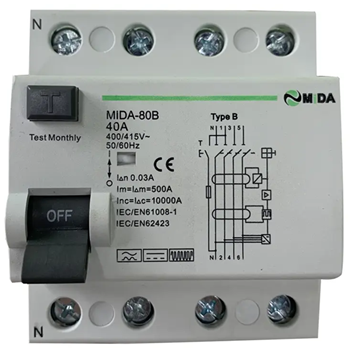
- Protection Type: It protects specifically against earth leakage (ground faults). Unlike an MCB, a standard RCCB does not protect against overloads or short circuits.
- Sensitivity: Common residential units trip at 30mA, which is the threshold to prevent serious harm to the human heart.
- Test Button: Every RCCB has a "Test" button that simulates a small leakage to verify the internal mechanism still works correctly. Experts recommend testing it monthly.
|