|
AFCI (Arc Fault Circuit Interrupter)
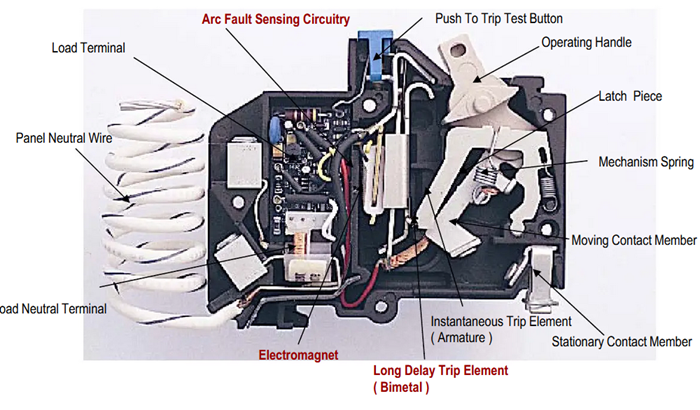
An Arc Fault Circuit Interrupter (AFCI) is a specialized circuit breaker that prevents electrical fires by detecting hazardous, unintended electrical arcs (sparks) caused by damaged wiring, loose connections, or broken insulation. It continuously monitors the circuit's current waveform, using microprocessors to identify specific high-frequency signatures—erratic, non-periodic signals—that differ from normal appliance operation. When a dangerous arc is detected, the AFCI instantly trips, cutting off power before the arc can ignite surrounding materials.
Key Working Principles of AFCI
- Constant Monitoring: The internal circuitry (microprocessor) monitors the current flowing through both the hot and neutral wires.
- Signature Recognition: It distinguishes dangerous, random arc signatures from normal arcs (like those in brushed motors or light switches).
- High-Frequency Detection: It looks for specific, unusual, and non-uniform current patterns, often including high-frequency noise above 100 kHz.
- Arc Types Detected:
- Parallel Arcs: Electricity jumping between hot and neutral/ground, often caused by wire damage.
- Series Arcs: Electricity jumping across a break in a single conductor, commonly caused by loose connections or broken wires.
- Automatic Trip: Upon detecting the unique signature of an arc fault, the breaker mechanism quickly opens, stopping the current flow.
Types of AFCIs
- Branch/Feeder AFCI: Protects the entire branch circuit from the panel.
- Outlet Branch Circuit (OBC) AFCI: Installed at the first outlet to protect the downstream circuit.
- Combination AFCI (CAFCITM): Detects both parallel and series arcs.
- Dual-Function AFCI/GFCI: Combines arc fault protection with ground fault protection.
An Arc Fault Circuit Interrupter (AFCI) is a specialized electrical safety device that prevents fires by detecting dangerous electrical arcing—sparks that occur when current "jumps" across gaps in damaged or loose wiring.
Core Working Principle
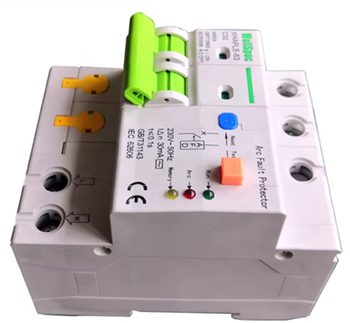
Unlike standard breakers that only react to high current (overloads) or direct contact (short circuits), an AFCI uses electronic waveform analysis to identify the unique "signature" of a dangerous arc.
| Component |
Trip Mechanism |
| Current Sensor |
Continuously monitors the electrical current and voltage waveforms flowing through the circuit. |
| Digital Signal Processor (Microprocessor) |
Samples the current thousands of times per second to capture a digital "snapshot" of the AC waveform. |
| Logic/Algorithm |
Compares the current waveform against a memory bank of known "dangerous" arc patterns. |
| Signature Analysis |
Differentiates between normal arcs (e.g., flipping a light switch, motor brushes in a vacuum) and hazardous arcs (e.g., frayed wires, loose terminals). |
| Trip Mechanism |
If a hazardous pattern is confirmed, it triggers a solenoid to open the internal contacts and de-energize the circuit within milliseconds. |
Types of Arcs Detected
Modern Combination AFCIs (the current standard required by the National Electrical Code) protect against two main types of faults:
- Series Arcs: Occur along a single conductor (e.g., a broken wire or a loose screw terminal). These often involve low current that standard breakers cannot detect.
- Parallel Arcs: Occur between two different conductors (e.g., hot-to-neutral or hot-to-ground). These can reach temperatures over 10,000°F, easily igniting building materials.
Summary of Safety Roles
- AFCI: Focuses on fire prevention by detecting arcing faults.
- GFCI: Focuses on shock prevention by detecting current leaking to the ground.
- Standard Breaker: Focuses on equipment protection from overloads and short circuits.
|