|
AFDD (Arc Fault Detection Device) - Working Principle
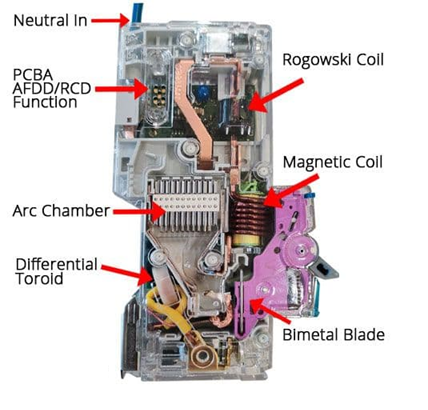
An Arc Fault Detection Device (AFDD) is a modern, smart circuit breaker installed in consumer units to prevent electrical fires by detecting dangerous, unintended electrical arcs that conventional breakers (MCBs/RCDs) miss. It uses microprocessor technology to analyze current and voltage waveforms in real-time, identifying the unique, high-frequency "signatures" of hazardous arcs and immediately cutting power.
Working Principle of an AFDD
- Constant Monitoring: The device continuously monitors the electrical waveform (current and voltage) in the circuit.
- Signature Analysis: A microprocessor analyzes the waveform for specific patterns—irregular, non-predictable, and persistent signals—that indicate a dangerous arc.
- Distinguishing Hazards: It distinguishes between "normal" arcs (e.g., from a vacuum cleaner motor or light switch) and "dangerous" arcs (e.g., damaged wire insulation, loose connections).
- Instant Tripping: Upon detecting a dangerous arc (parallel or series), the AFDD triggers a tripping mechanism to instantly disconnect the circuit.
Key Features & Functions
- Advanced Protection: Unlike MCBs (overload/short-circuit) or RCDs (leakage), AFDDs detect low-energy arcs that can cause fires.
- Types of Arcs Detected:
- Parallel Arcs: Between live and neutral/ground.
- Series Arcs: Within a single broken conductor.
- Application: Ideal for protecting final circuits in homes, schools, and care homes.
An Arc Fault Detection Device (AFDD)—often called an Arc Fault Circuit Interrupter (AFCI) in North America—is a specialized safety device designed to detect and interrupt dangerous electrical arcs that can cause fires. Unlike standard circuit breakers (MCBs) that trip during short circuits or overloads, an AFDD identifies low-level "sparking" that would otherwise go unnoticed.
Working Principle
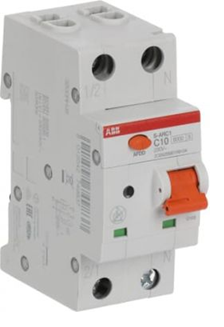
The core of an AFDD is a microprocessor running sophisticated algorithms that continuously analyze the electrical current's waveform (the shape of the electricity).
| Component/Feature |
Function in Working Principle |
| Waveform Analysis |
Samples the AC sine wave thousands of times per second to detect irregularities. |
| Signature Detection |
Identifies the unique "fingerprint" of a dangerous arc: high-frequency noise (100 kHz to several MHz) and erratic, jagged current spikes. |
| Logic Discrimination |
Uses algorithms to distinguish between harmful arcs (caused by damaged wires) and operational arcs (normal sparks from a light switch or motor brushes in a vacuum). |
| Instant Trip |
Once a dangerous arc is confirmed, the microprocessor sends a signal to a mechanical trip unit to disconnect the power in a fraction of a second. |
Types of Arcs Detected
AFDDs are primarily designed to catch two types of hazardous faults:
- Series Arcs: Occur within a single conductor (e.g., a frayed appliance cord or a loose screw terminal). These are the most dangerous because the current is often too low to trip a standard breaker.
- Parallel Arcs: Occur between two different conductors (line-to-neutral or line-to-earth), often due to damaged insulation.
Comparison with Other Devices
| Device |
Protects Against... |
Detects Arc Faults? |
| MCB (Miniature Circuit Breaker) |
Overloads and Short Circuits |
No |
| RCD/RCCB (Residual Current Device) |
Earth leakage and Electric shock |
No (Except some ground faults) |
| AFDD |
Hazardous electrical arcing (Fire prevention) |
Yes |
Many modern AFDDs are "all-in-one" devices (e.g., RCBO-AFDD) that combine arc fault detection with overload and shock protection in a single module.
|