|
Thermal Protection Circuit breaker - Working Principle
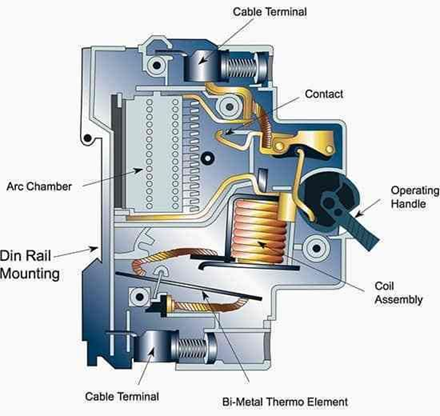
A thermal protection circuit breaker protects circuits from overloads (slow, prolonged excess current) using a bimetallic strip that heats up and bends, triggering a trip mechanism to cut power when current exceeds set limits. It acts as a safety device that triggers slowly—taking seconds or minutes—to prevent wiring from melting or catching fire.
Core Working Principle Components
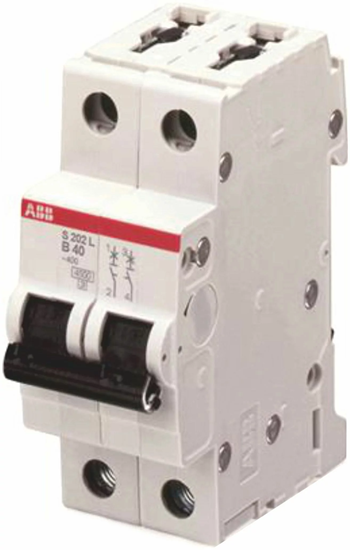
- Bimetallic Strip: Made of two different metals bonded together, which expand at different rates when heated.
- Heating Mechanism: When overload current flows, the bimetallic strip heats up.
- Deflection: Due to different expansion rates, the heated strip bends.
- Tripping Mechanism: The bending strip pushes a lever, breaking the electrical connection and cutting power.
Key Characteristics
- Purpose: Protects circuits from overloads (e.g., too many devices plugged in).
- Action Type: Slow acting; it requires time for heat to build up.
- Distinction from Magnetic: Unlike magnetic protection (which handles instant short circuits), thermal protection handles sustained, moderate excess current.
- Resettable: Once cooled, the strip returns to its original shape, allowing the circuit breaker to be reset.
Thermal protection is the mechanism within a circuit breaker designed to safeguard electrical systems against overloads—conditions where a circuit carries more current than it is rated for over a prolonged period.
Working Principle: The Bimetallic Strip
The core of a thermal circuit breaker is a bimetallic strip, which consists of two different metals bonded together, each with a different coefficient of thermal expansion.
| Phase |
Description |
| Normal Flow |
Current passes through the bimetallic strip. At rated levels, the heat generated is insufficient to cause significant deformation. |
| Overload |
As current exceeds the rating, the bimetallic strip heats up. Because the two metals expand at different rates, the strip begins to bend or warp. |
| Tripping |
Once the strip bends to a predetermined point, it physically pushes a trip bar or latch mechanism. This releases the spring-loaded contacts, instantly breaking the circuit. |
| Resetting |
After the strip cools and returns to its original shape, the breaker can be manually reset to resume operation. |
Key Characteristics
- Time-Inverse Response: The tripping time is "inverse"—the higher the current (the greater the overload), the faster the bimetallic strip heats up and trips the breaker.
- Intentional Delay: Unlike magnetic protection, thermal protection is deliberately slow (seconds to minutes). This allows for temporary "inrush currents," such as when a motor first starts up, without causing a "nuisance trip".
- Ambient Sensitivity: Because it relies on heat, these breakers can be affected by the surrounding temperature. In very hot environments, they may trip slightly below their rated current.
Thermal vs. Magnetic Protection
Most modern units are thermal-magnetic circuit breakers, combining two separate mechanisms to provide complete protection.
| Feature |
Thermal Protection |
Magnetic Protection |
| Primary Fault |
Overload (e.g., too many appliances) |
Short Circuit (e.g., direct wire contact) |
| Mechanism |
Bimetallic Strip (Heat-based) |
Electromagnetic Coil (Magnetic field) |
| Reaction Speed |
Slow (Seconds/Minutes) |
Instantaneous (Milliseconds) |
| Purpose |
Prevents long-term cable/insulation damage |
Prevents explosive damage and fire |
|




