|
Arcing contacts of a circuit breaker
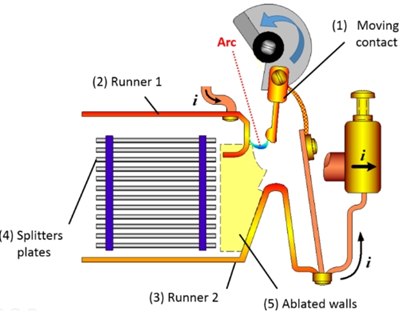
Arcing contacts in a circuit breaker are specialized, high-temperature-resistant, tungsten-coated components that separate after the main contacts to manage and extinguish the electrical arc formed during circuit interruption. They prevent damage to the main contacts by guiding the arc into a quenching chamber, ensuring safe, rapid circuit disruption.
Working Principle and Function
- Sequential Separation: When a breaker opens, the main contacts separate first, followed by the arcing contacts.
- Arc Initiation: As the current-carrying paths break, an ionized, high-temperature plasma (arc) forms between the separating arcing contacts.
- Arc Handling: Because the arcing contacts are designed to withstand high temperatures and are made of robust materials like tungsten, they absorb the damage from the arc rather than the main contacts.
- Arc Quenching: The arc is guided into an arc chute or chamber where it is stretched, cooled, and extinguished (de-ionized) by methods such as oil, air blast, or vacuum.
- Protection: By quickly extinguishing the arc, these contacts stop current flow and protect the main contact surfaces from burning or erosion.
Key Aspects
- Material: Usually, high-strength alloys or tungsten, which can withstand intense heat.
- Structure: Located within the arc interrupter chamber to ensure arc containment.
- Purpose: To prolong the service life of the circuit breaker by sacrificing themselves to the harsh arc environment.
In a circuit breaker, arcing contacts are secondary contacts specifically designed to handle the intense heat and erosion of the electrical arc formed during the opening and closing of a circuit. Their primary purpose is to protect the main contacts, which are made of high-conductivity materials (like silver-plated copper) and carry the continuous load current.
Working Principle
The system operates on a "make-first, break-last" sequence to ensure the arc never touches the delicate main contacts.
| Operation |
Step-by-Step Mechanism |
Goal |
| Opening (Breaking) |
1. Main Contacts Open First: The current is diverted to the still-closed arcing contacts.
2. Arcing Contacts Open Last: As they separate, the arc forms only between these rugged tips.
3. Arc Extinction: The arc is drawn into an arc chute where it is split, cooled, and extinguished. |
Protect the low-resistance main contacts from heat damage and pitting. |
| Closing (Making) |
1. Arcing Contacts Close First: Any pre-arcing (sparking) occurs between these heat-resistant tips.
2. Main Contacts Close Last: Once a solid physical connection is established, the main contacts close to carry the full load. |
Prevent the main contacts from welding together due to closing sparks. |
Key Characteristics
Material: Arcing contacts are typically made from Copper-Tungsten alloys. Tungsten provides a very high melting point (approx. 3,422°C) to resist erosion, while copper provides the necessary electrical and thermal conductivity to dissipate heat.
Location: They are often shaped like "horns" or probes and are positioned above or to the side of the main contacts, leading directly into the Arc Chute.
Maintenance: Because they "take the beating," these contacts are designed to be easily inspected and replaced as they wear down over time.
|