|
Main Contacts of a Circuit Breaker - Working Principle
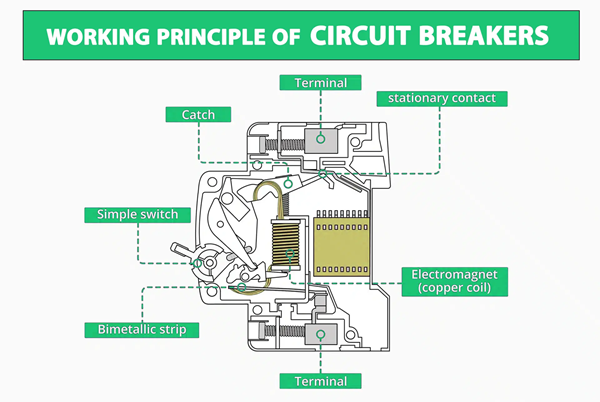
Circuit breaker main contacts—comprising fixed and moving metallic electrodes—conduct normal current while held together by spring pressure. Under fault conditions (overload/short circuit), the operating mechanism releases stored energy to separate these contacts rapidly, breaking the circuit and extinguishing the resulting arc to prevent damage.
Key Aspects of Main Contacts:
- Structure: Composed of a stationary (fixed) contact and a moving contact, often located within an arc-quenching chamber.
- Normal Operation: Held closed by mechanical pressure (springs or compressed air), allowing electricity to flow.
- Fault Operation: When an overload or short circuit occurs, a trigger mechanism (thermal-magnetic) breaks the contact holding pressure, forcing the moving contact away from the stationary one.
- Arc Management: Upon separation, an electrical arc forms. The contact design ensures that the main contacts open first, transferring the current to arcing contacts (if equipped) to prevent damage to the main contact surfaces.
- Materials: Typically made of high-conductivity materials with high melting points, such as copper alloys or silver-tungsten, to withstand extreme temperatures
Working Principle in Detail
- Closed State: Under normal conditions, the spring mechanism keeps the main contacts touching, allowing current to pass.
- Tripping: When a fault occurs, the mechanism is triggered by an electromagnetic coil (short circuit) or bimetallic strip (overload), causing the moving contact to pull away from the fixed contact.
- Arc Extinction: As the contacts open, current continues to flow through the air gap as plasma (the arc). The circuit breaker is designed to extinguish this arc using mediums like air, oil, or vacuum.
- Open State: Once the arc is extinguished, the circuit is safely interrupted.
The main contacts of a circuit breaker are the primary conductors designed to carry the full rated load current of an electrical system during normal operation. In power circuit breakers, they work alongside arcing contacts to protect the breaker's internal components from damage during the switching process.
Working Principle: Opening & Closing Sequence
To prevent electrical arcs (sparks) from damaging the main contacts, they operate in a specific sequence relative to the arcing contacts:
| Operation |
Step |
Description |
| Opening (Tripping) |
1 |
Main Contacts part first. Since the arcing contacts are still closed, current is diverted to them, preventing an arc on the main contacts. |
| Closing |
2 |
Arcing Contacts part second. An electric arc forms only across these contacts, which are made of high-temperature resistant materials. |
|
1 |
Arcing Contacts meet first. They "take the hit" of any pre-arcing that occurs as the gap closes. |
|
2 |
Main Contacts meet second. Once fully closed, they carry the continuous current because they have lower resistance. |
Design and Material Features
- Low Resistance: Main contacts are typically larger and made of highly conductive materials like silver alloys or copper to minimize heat during normal operation.
- Protection: By ensuring arcing only occurs on specialized arcing contacts (often made of harder materials like tungsten), the main contacts remain smooth and free of "pitting," ensuring a reliable low-resistance connection.
- Spring Pressure: Mechanical springs provide constant pressure to hold the main contacts together securely, preventing accidental gaps that could cause overheating.
In some smaller breakers, like Miniature Circuit Breakers (MCB) or Vacuum Circuit Breakers, there may only be one set of contacts that handle both the load current and the arc.
|




