|
An arc suppressing chamber (or arc chute) in a circuit breaker - Working Principle
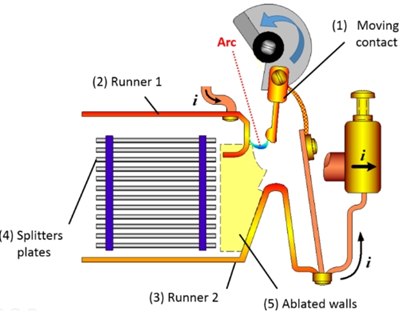
An arc suppressing chamber (or arc chute) in a circuit breaker extinguishes the high-temperature plasma arc formed during contact separation by forcing it into a chamber, where it is split, elongated, and cooled until it deionizes and breaks. It works through methods like magnetic repulsion, splitter plates, or air/gas blast to accelerate cooling.
Core Working Principle
- Arc Formation: When circuit breaker contacts open under load, a highly conductive plasma arc forms between them.
- Arc Movement: Magnetic fields (magnetic blowout) or thermal buoyancy push this arc upward into the arc chamber, which contains a series of metal splitter plates (arc chutes).
- Splitting and Cooling: The arc is forced onto the plates, splitting one large arc into several smaller ones.
- Extinction: These smaller arcs lose energy quickly upon contact with the metal plates and the surrounding air, reducing the temperature and interrupting the ionized path.
- Interruption: Within milliseconds, the dielectric strength of the gap is restored, and the arc is extinguished, opening the circuit.
Common Arc Suppression Techniques
- Grid/Splitter Plates (Air Circuit Breakers): Uses metal grids to split and cool the arc.Magnetic Blowout: Employs a magnetic field to move the arc into the chamber faster.
- Gas-Blast/SF6: Uses pressurized Sulfur Hexafluoride (SF6) to cool and deionize the arc rapidly.
- Vacuum Interrupter: A vacuum prevents ion formation, causing the arc to dissipate instantly when current approaches zero.
The Arc Suppressing Chamber (often called an arc chute or extinguishing chamber) is the critical component where the electrical arc is neutralized when contacts separate under load. Its primary purpose is to prevent the arc from damaging the breaker or causing a fire by rapidly cooling and deionizing the plasma.
Working Principles of Arc Suppression
| Mechanism |
Description |
Key Components |
| Splitting (Grid Method) |
The arc is pushed into a series of insulated metal plates (arc chutes). This divides one large, high-energy arc into many smaller segments, each with its own cathode/anode voltage drop, making it unsustainable. |
Splitter plates / Arc grids |
| Lengthening (Stretching) |
Magnetic fields or mechanical movement force the arc to travel a longer path. Stretching the arc increases its resistance and surface area, which enhances cooling and deionization. |
Magnetic blowout coils |
| Cooling |
The chamber is designed to conduct heat away from the arc. This reduces the energy of the plasma until the temperature drops below the level required for ionization. |
Steel or ceramic plates |
| Deionization |
As the arc touches the cool surfaces of the plates or slits, the ionized gas particles recombine into neutral atoms, restoring the dielectric strength of the gap. |
Deionizing plates |
The Suppression Process
- Arc Initiation: As the moving contact pulls away from the fixed contact during a fault, the air or medium between them ionizes, forming a high-temperature plasma arc.
- Directional Movement: A magnetic force (often created by the current itself or "blowout coils") pushes the arc away from the contacts and toward the suppression chamber.
- Extinction: Inside the chamber, the arc is stretched and split by the grid plates. This increases the total resistance and cools the plasma.
- Dielectric Recovery: Once the current passes through zero (in AC systems), the rapid cooling and deionization prevent the arc from restriking, safely isolating the circuit.
In specialized breakers, such as Vacuum or SF6 types, the chamber is sealed and uses a high-dielectric medium (vacuum or sulfur hexafluoride gas) to suppress the arc even faster by preventing ionization from the start.
|




