
|
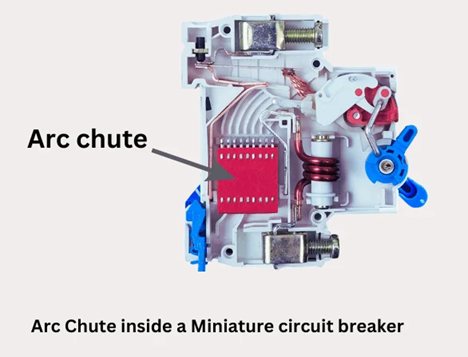
Arc chutes in circuit breakers - Working Principle
Arc chutes in circuit breakers are safety devices, consisting of stacked insulated metal plates, designed to extinguish electric arcs formed during circuit interruption. They function by breaking a single large arc into smaller segments (splitting), cooling them down, and lengthening the arc path (stretching) until the arc voltage exceeds the system voltage, causing it to die out. Working Principle Steps
Arc chutes are crucial in air circuit breakers to protect contacts from melting and prevent fires. Arc chutes are essential safety components in circuit breakers designed to rapidly extinguish the electrical arc that forms when contacts separate under load or fault conditions. Without them, these high-temperature arcs (reaching thousands of degrees Celsius) could damage internal components or cause fires. Working Principle The arc chute operates on the "High Resistance" principle, which aims to increase the arc's resistance until the system voltage can no longer sustain it. It achieves this through four primary mechanisms:
Key Components
Applications Arc chutes are the primary quenching method for Low Voltage (LV) and Medium Voltage (MV) devices, such as:
For high-voltage systems (above 35kV), arc chutes become impractically large; these systems instead use Vacuum, SF6 gas, or Air-blast technology to quench arcs.
|

+(39) 347 051 5328
Italy - Kazakhstan


09.00am to 18.00pm
About
We offer the best and economical solutions, backed by 27+ years of experience and international standards knowledge, echnological changes, and industrial systems.
Our Services
Marketing Materials


Marketing Materials1


