|
Arc Runners of a circuit breaker - working principle
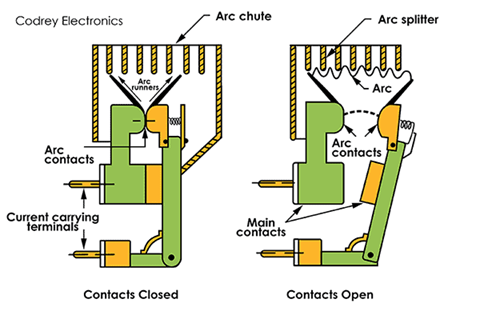
Arc runners in circuit breakers are conductive, arc-resistant metal extensions that guide the electric arc away from the main contact points into an arc chute for rapid extinguishing. By stretching and pulling the arc, they prevent contact damage, reduce arc energy, and accelerate the interruption of fault currents.
Working Principle
- Arc Initiation: When the circuit breaker opens under a fault, a high-temperature arc forms between the main separating contacts.
- Transfer to Runners: The arc, which has a natural magnetic field (Lorentz force) and is often pushed by hot gases, is attracted to the arc runners connected to the contacts.
- Moving the Arc: The runners are shaped to guide the arc away from the contact points upward towards the arc chute (splitter plates).
- Stretching and Cooling: As the arc travels along the runners, it is elongated, increasing its resistance and voltage drop.
- Extinction: The arc is moved into the arc splitter plates, where it is broken into smaller arcs and cooled until the current passes through zero, permanently extinguishing it.
Key Benefits
- Protection: Prevents damage to the main current-carrying contacts by limiting the duration and location of the arc.
- Efficiency: Enables faster arc quenching by moving it directly into the arc chamber.
- Design: Often constructed of durable materials (e.g., copper alloy) designed to withstand extreme thermal stress.
In a circuit breaker, arc runners are conductive, often horn-shaped or V-shaped metal plates designed to "catch" and transport the electrical arc away from the primary contacts to the arc chute for quenching.
Working Principle
The operation of an arc runner follows a specific sequence during a fault:
- Arc Formation: As the circuit breaker contacts separate, the surrounding air ionizes, forming a high-temperature conductive plasma (the arc).
- Arc Transfer: Because arc runners are physically adjacent to or coextensive with the fixed contact, the "feet" of the arc naturally jump from the expensive contact material onto the arc runner.
- Upward Movement: The arc is driven along the runners toward the arc chute by two forces:
- Thermal Effect: The intense heat causes the arc to rise naturally.
- Electromagnetic Force (Magnetic Blow-out): The current flowing through the arc creates a magnetic field that exerts a Lorentz force, pushing the arc deeper into the quenching chamber.
- Lengthening & Cooling: As the arc moves along the divergent path of the V-shaped runners, its length increases, which raises its electrical resistance and decreases the current.
Key Benefits
| Feature |
Function |
| Contact Protection |
Moves the arc away from silver alloy contacts to prevent pitting and melting. |
| Arc Transport |
Acts as the transfer medium between the contact region and the arc chute. |
| Resistance Increase |
Stretches the arc path, forcing it to cool and lose energy |
This mechanism is a standard feature in Air Circuit Breakers (ACB) and Molded Case Circuit Breakers (MCCB) used in industrial and commercial power distribution.
|




