|
Stored Energy Mechanism of a circuit breakers - working principle
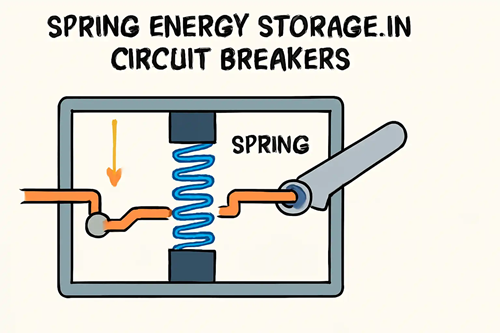
A Stored Energy Mechanism (SEM) in electrical switchgear opens and closes circuit breakers by pre-compressing springs using a motor or manual handle, storing mechanical energy. Upon a signal, the released spring force instantly operates the contacts, ensuring rapid, independent, and high-speed operation (approx. 100 ms).
Key Aspects of the Working Principle:
- Energy Storage (Charging): A motor or manual handle compresses closing and/or opening springs, storing potential energy. This is called "charging" or "pre-storing" energy.
- Holding Mechanism: The springs are held in the compressed state by close/trip latches.
- Release (Operation): When a closing or tripping signal is received, the respective latches release the stored spring energy to move the contacts instantly.
- Independence: The operation speed of the mechanism is independent of the operator's speed.
- Types:
- Single Spring: One spring handles both opening and closing.
- Two-Step/Double Spring: Separate springs for closing and opening, allowing for faster closing and independent operation (e.g., Open-Close-Open duty cycles).
Advantages:
- High-speed operation crucial for breaking high currents.
- Remote operating capability.
- Simple, reliable, and provides consistent mechanical force.
In the context of electrical switchgear and circuit breakers, a Stored Energy Mechanism (SEM) is a device that uses potential energy (typically from compressed springs) to operate the contacts.
The core principle is to ensure the speed of operation is independent of the human operator or the control voltage, which is critical for safety and for extinguishing powerful electric arcs during a fault.
Working Principle Breakdown
| Phase |
Description |
Key Components |
| 1. Charging |
Energy is stored by compressing or stretching a set of springs. This can be done manually (via a handle) or electrically (via a small motor). |
Motor, Charging Handle, Ratchet/Pawl |
| 2. Holding |
Once fully charged, the springs are held in a high-tension state by a mechanical latch or trigger system. |
Close/Open Latches, Cam |
| 3. Releasing |
A small force (mechanical push-button or electrical signal to a solenoid) trips the latch, releasing the stored energy. |
Solenoid, Plunger, Trigger |
| 4. Actuation |
The released energy rapidly moves the breaker's contacts to either close or open the circuit, typically within 100 milliseconds. |
Moving Contacts, Linkage |
Common Types of Mechanisms
- Spring-Operated: Most common; uses elastic potential energy in metal springs.
- Two-Step Stored Energy: Features separate opening and closing springs. This allows for an O-C-O (Open-Close-Open) duty cycle, meaning the breaker can re-close immediately after a trip without needing to wait for a recharge.
- Pneumatic/Hydraulic: Uses compressed air or pressurized oil to move the contacts, often found in very high-voltage systems.
Why Stored Energy is Used
- Rapid Interruption: Fast contact separation is essential to prevent contacts from melting due to high-current arcing.
- Reliability: The mechanism provides a consistent force regardless of how fast or slow a person pulls a handle.
- Remote Control: Allows the breaker to be operated from a safe distance using electrical signals.
Warning: Stored energy mechanisms remain hazardous even when the main power is disconnected. They must be safely discharged before performing maintenance to prevent accidental firing.
For a detailed look at specific product implementations, you can refer to technical guides from manufacturers like Schneider Electric or Eaton.
|