|
Manual Energy Storage Handle of a circuit breaker - working principle
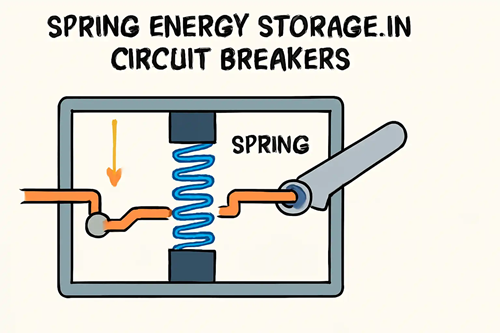
A manual energy storage handle on a circuit breaker compresses a spring mechanism through multiple strokes, storing potential energy to ensure fast, reliable closing of contacts, especially under fault conditions. The mechanism uses a cam and roller to lock the spring, which is released by a push button, independent of the user's manual speed.
Working Principle in Detail
- Charging: An operator pulls the manual handle (usually 6-7 times) to compress the closing spring. This action charges the spring, storing potential energy, and an indicator shows "Charged".
- Mechanism Lock: A locking hook holds the compressed spring in place.
- Closing: When the "ON" button is pressed, the hook releases the cam and roller assembly. The stored energy in the spring rapidly rotates the cam, driving the mechanism to close the circuit breaker contacts instantly.
- Safety Function: This manual method allows the breaker to close reliably even if there is no electrical power to operate a motorized charging mechanism.
- Opening: A separate mechanism and spring, usually charged automatically during the closing process, are used to open the circuit.
This mechanism ensures high-speed operation necessary for arc quenching in circuit breakers.
The manual energy storage handle of a circuit breaker (often found on
Air Circuit Breakers or Vacuum Circuit Breakers) operates on the principle of stored mechanical energy. It allows an operator to manually compress high-tension springs so the breaker can close with high speed and force, independent of the operator's manual strength or speed.
Core Working Principle
The handle acts as a lever to drive a ratchet and pawl mechanism, which incrementally compresses a large closing spring.
| Component |
Function |
| Manual Handle |
Provides leverage for the operator to input mechanical work. |
| Ratchet Wheel |
Converts the back-and-forth handle motion into one-way rotational motion. |
| Closing Spring |
Stores potential energy when compressed (the "Charging" phase). |
| Latch Mechanism |
Locks the spring in its fully compressed (charged) state until released. |
| Indicator |
A visual "Charged/Discharged" flag showing the spring's status. |
Step-by-Step Operation
- Charging (Energy Storage): The operator pumps the handle (usually 6–10 times). Each stroke rotates a ratchet wheel that gradually compresses the closing spring.
- Locking: Once fully compressed, a closing latch snaps into place, holding the energy in the spring. A "Charged" indicator will appear on the front panel.
- Ready State: The breaker is now "Charged but Open." It has enough stored energy to close the contacts instantly when the "Close" button is pressed.
- Release (Closing): When the "Close" command is given (mechanical or electrical), the latch is released. The spring rapidly expands, driving the contacts together to complete the circuit.
Why is this necessary?
- Speed: High-voltage contacts must close extremely fast to minimize electrical arcing. Human hands cannot move fast enough to prevent contact damage.
- Emergency Operation: If the internal charging motor fails or there is a total power loss, the manual handle ensures the breaker can still be operated safely.
- Safety: The "stored energy" design ensures that once the spring is released, the closing speed is constant, preventing "teasing" the contacts.
|