|
ACB (Air Circuit Breaker) circuit breaker - Working Principle
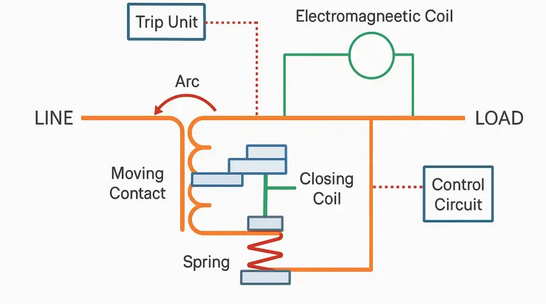
An Air Circuit Breaker (ACB) functions by automatically breaking electrical circuits during faults (overload/short-circuit) using atmospheric air to extinguish the electric arc. When contacts separate, an arc forms; the ACB elongates, splits, and cools this arc within arc chutes, using air pressure to extinguish it and safely interrupt the current.
Core Working Principle
- Fault Detection: The ACB detects overcurrent or short circuits, triggering the operating mechanism.
- Contact Separation: The main contacts separate, followed by arcing contacts, creating an electric arc.
- Arc Movement & Splitting: The arc is driven into specialized arc chutes by magnetic forces.
- Arc Quenching (Extinguishing): Inside the chutes, the arc is split into smaller, cooler segments by metal plates, extinguishing it.
Key Components & Features
- Arc Chutes: Fireproof, insulated chambers that divide and cool the arc.
- Arc Runners/Contacts: Specialized, heat-resistant contacts that handle the intense heat of the arc.
- Operating Mechanism: Often uses a spring-charged mechanism to open/close contacts quickly.
- Usage: Commonly used in low-voltage applications up to 1000V AC and currents from 400A to 6300A, such as in commercial buildings and industrial plants.
Types of ACBs based on Air Medium
- Plain Break: Utilizes natural air to extinguish the arc.
- Air Blast: Uses high-pressure air blast to blow out the arc, often used in higher voltage, medium-to-high applications.
An Air Circuit Breaker (ACB) is an electrical protection device that uses atmospheric air as the medium to extinguish the electrical arc formed when contacts separate under fault conditions. It is primarily used for low-voltage (up to 690V) and high-current (up to 6300A) industrial applications.
Core Working Principle
The fundamental principle of an ACB is to prevent the re-ignition of an electrical arc by increasing its resistance until the system voltage can no longer sustain it. This is achieved in three main stages:
| Stage |
Process |
Description |
| 1. Fault Detection |
Sensing |
The Trip Unit (thermal, magnetic, or electronic) monitors current levels. If it detects an overload or short circuit, it triggers the operating mechanism. |
| 2. Contact Separation |
Arc Formation |
The moving contacts pull away from the fixed contacts. As they separate, the high voltage ionizes the air, creating a hot, conductive Electrical Arc. |
| 3. Arc Quenching |
Extinction |
The arc is forced into the Arc Chute. Here, it is stretched, cooled, and split into smaller segments by metal plates, rapidly increasing its resistance until it vanishes. |
Key Components & Their Roles
- Main Contacts: Usually made of copper, these carry the normal load current.
- Arcing Contacts: Made of heat-resistant alloys (like carbon), these open last and close first to take the "hit" from the arc, protecting the main contacts from erosion.
- Arc Chute: A chamber containing Splitter Plates that divide the arc into several smaller arcs, cooling them and dissipating energy.
- Operating Mechanism: A spring-loaded system (manual or motorized) that ensures the contacts open or close with enough speed and force to handle high fault currents.
Types of ACBs
Depending on how the air interacts with the arc, ACBs are categorized as:
- Plain Break Type: The arc extends naturally between horn-shaped contacts in open air; used for lower power.
- Magnetic Blowout Type: Uses a magnetic field to physically "blow" or push the arc into the chutes faster.
- Air Blast Circuit Breaker: Uses a high-pressure Air Blast to sweep away ionized gases; typically used in very high-voltage systems (up to 420kV).
|




