|
VCB (Vacuum Circuit Breaker) circuit breaker - Working Principle
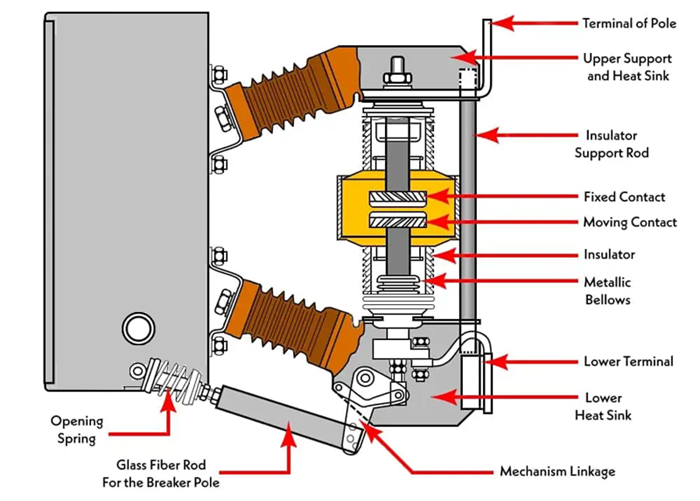
A Vacuum Circuit Breaker (VCB) functions by separating contacts within a high-vacuum chamber (<10-6 torr) to extinguish arcs. When a fault occurs, contacts open, creating an arc from metal vapors, which rapidly dissipates and condenses on shields in the vacuum, quenching the arc at current zero.
Key Working Principles
- Arc Initiation: Upon opening, the contact material vaporizes, creating a conductive plasma arc.
- Rapid Extinction: Because there is no gas to ionize in a vacuum, the arc cannot sustain itself.
- Dielectric Recovery: The metal vapor condenses quickly on the shield and contacts, allowing the vacuum to regain high dielectric strength.
- Current Interruption: The arc is extinguished at the first current zero, preventing re-ignition.
Key Features & Advantages
- High Dielectric Strength: Vacuum is an excellent insulator.
- Fast Operation: Suitable for high-voltage and frequent switching.
- Low Maintenance: Long lifespan with little maintenance required.
- Compact Design: Ideal for medium-voltage switchgear.
A Vacuum Circuit Breaker (VCB) is an electrical switching device that uses a high vacuum (10-7 to 10-5 torr - unit of measurement (equivalent to 1 mmHg) as an arc-quenching medium to safely interrupt current flow. They are primarily utilized in medium-voltage systems ranging from 1kV to 38kV due to their reliability and compact design.
Core Working Principle
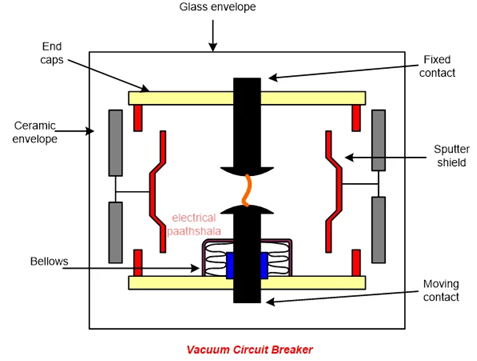
The VCB operates by rapidly separating its electrical contacts within a sealed vacuum chamber to extinguish the resulting arc.
| Phase |
Description |
| Normal State |
Contacts remain closed within the Vacuum Interrupter, allowing electricity to flow uninterrupted. |
| Fault Detection |
A protective relay senses an abnormality (short circuit or overload) and sends a trip signal to the Actuator Mechanism. |
| Contact Separation |
The mechanism (typically spring or motor-operated) pulls the Movable Contact away from the Fixed Contact. |
| Arc Formation |
As contacts part, current ionizes metal vapors from the contact surfaces, creating a temporary electrical arc. |
| Arc Quenching |
In a vacuum, there are no gas molecules to sustain the arc. Metal vapors quickly condense back onto contact surfaces or Arc Shields, causing the arc to collapse. |
| Dielectric Recovery |
The dielectric strength of the vacuum recovers almost instantly (within milliseconds), preventing the arc from re-striking as the current reaches its first zero crossing. |
Key Components
- Vacuum Interrupter: The core "bottle" where contacts are housed in a high vacuum.
- Contacts: Often made of specialized alloys like Copper-Chrome to withstand high temperatures and ensure good conductivity.
- Metallic Bellows: Stainless steel flexible parts that allow the movable contact to shift without breaking the vacuum seal.
- Arc Shield: A metal enclosure that prevents vaporized metal from contaminating the insulating walls of the interrupter.
Why Use a VCB?
- Fast Operation: Arcs are extinguished within roughly half an AC cycle (~10ms).
- Low Maintenance: The sealed environment prevents oxidation, requiring minimal upkeep compared to oil or air breakers.
- Eco-Friendly: Unlike SF6 breakers, VCBs use no toxic gases or oils, eliminating fire and environmental hazards.
To finalize a specific recommendation for your setup, provide the rated voltage and current of your electrical system.
|