|
Secondary Circuit Terminals of a circuit breaker - Working Principle
Secondary circuit terminals on a circuit breaker, often found as a secondary disconnect plug or terminal block, serve low-voltage control, monitoring, and protection functions (e.g., signaling, tripping, status indication). They facilitate communication between the breaker's internal mechanisms and external control systems, such as relay protections.
Working Principle and Key Functions
- Trip Coil Operation (Shunt Trip/Under-voltage): The terminals receive an external signal (e.g., from protective relays) to energize a trip coil or release a mechanism, which breaks the main circuit.
- Status Monitoring (Auxiliary Contacts): These terminals connect to auxiliary switches to provide feedback to operators on whether the main contacts are open or closed.
- Secondary Injection Testing: In solid-state breakers, these terminals are used to test the trip unit's functionality without passing current through the main primary contacts.
- Control Power: They provide the necessary power supply for internal electronic circuits, motor operators (for charging springs), or monitoring equipment.
These terminals typically operate in the range of 120V AC or low-voltage DC, acting as a link between high-voltage power components and low-voltage control, protection, or measurement devices.
In a circuit breaker, Secondary Circuit Terminals (often called the secondary disconnects) are the interface points between the breaker’s internal control components and the external low-voltage control system. Unlike the primary terminals that carry high-voltage power to the load, secondary terminals handle the "intelligence" of the breaker.
Working Principle
The secondary terminals operate on the principle of electrical isolation and feedback loops. They allow low-voltage control signals (typically 24V-250V AC/DC) to manage high-voltage operations without direct physical contact between the two power levels.
| Component |
Function |
Working Principle |
| Trip Coil |
Remote Tripping |
When a signal from a remote relay or PLC hits these terminals, the coil energizes, pulling a latch that mechanically forces the breaker to open. |
| Closing Coil |
Remote Closing |
Energizing these terminals activates a solenoid that releases the stored energy in the closing springs to snap the contacts shut. |
| Auxiliary Contacts |
Status Feedback |
These are mechanically linked to the main bridge. When the breaker opens/closes, these contacts "mimic" the state to send a "Breaker Open" or "Breaker Closed" signal to a control room. |
| Charging Motor |
Energy Storage |
Power supplied through these terminals runs a small motor that automatically "charges" (compresses) the springs after every operation so the breaker is ready for its next cycle. |
| Undervoltage Trip |
Safety Interlock |
If the voltage at these terminals drops below a set threshold (e.g., 35-70%), a plunger is released to trip the breaker, protecting downstream equipment from "brownouts". |
Practical Application
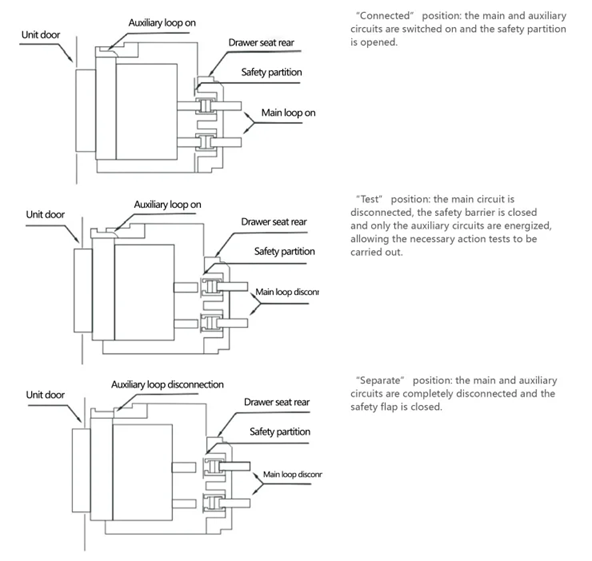
- Drawout Breakers: In Medium Voltage (MV) breakers, secondary terminals are often "plug-in" style. When you "rack in" the breaker, these pins engage first, allowing you to test the control logic before the high-power primary contacts touch.
- Secondary Injection Testing: Technicians use these terminals to perform Secondary Injection Tests, where they simulate a fault by injecting current directly into the trip unit via the secondary pins to verify the breaker's timing without needing thousands of amps of real power.
|