|
Safety Interlocks of a circuit breaker - Working Principle
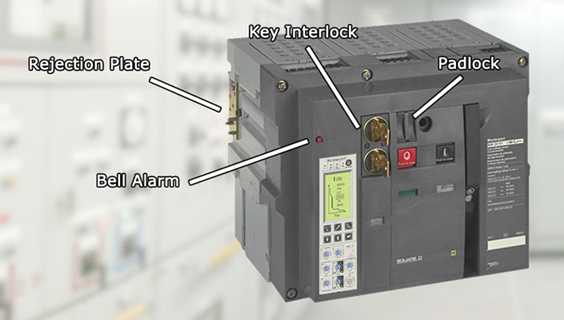
Safety interlocks for circuit breakers are mechanical or electrical, often NC (Normally Closed) systems designed to prevent hazardous situations, such as racking in a closed breaker or accessing live components. They ensure safety by enforcing a strict, correct sequence of operations (e.g., Open Disconnect Ground).
Key Working Principles & Types
- Mechanical Interlocks: These physical constraints stop movement. Examples include:
- Racking Interlocks: Prevent inserting or withdrawing a breaker unless it is in the open position.
- Cradle Rejection: Steel pins ensure a breaker only fits into its correct matching compartment.
- Closing Spring Interlocks: Ensure the closing spring is discharged during movement.
- Electrical Interlocks: Utilize auxiliary contacts on relays, contactors, or the breaker itself to prevent simultaneous, unsafe operation (e.g., preventing a standby generator breaker from closing while the main utility breaker is closed).
- Trapped Key Interlocks: A sequence-based system where a key is trapped in a device until it is in a safe state (e.g., breaker is open). That released key is then required to unlock another device, such as a cubicle door or earthing switch.
Common Safety Rules Enforced
- Prevent Closing in Move: The breaker cannot be closed while being moved between "Test" and "Connected" positions.
- Open Before Racking: The breaker must be opened before being moved out of the operating position.
- Grounding Safety: Grounding switches cannot be closed while the circuit is live.
Benefits
These interlocks ensure personnel safety by eliminating human error, preventing arc flash hazards, and protecting equipment during maintenance.
Safety interlocks for circuit breakers are critical mechanisms designed to prevent incorrect operations that could lead to equipment damage or severe personnel injury. They function by ensuring a mandatory sequence of operations based on the status of the equipment.
Core Working Principles
Safety interlocks generally operate through three primary methods:
- Mechanical Interlocks: Use physical constraints such as cams, levers, pins, or sliding plates to block movement. For example, a physical bar may block a breaker from being "racked in" if the contacts are currently closed.
- Electrical Interlocks: Use auxiliary contacts and control wiring. If a required condition is not met (e.g., an isolator is closed), the electrical circuit to the breaker’s closing coil remains open, preventing it from energizing.
- Logic-Based Interlocks: Found in modern switchgear, these use software logic in PLCs or SCADA systems to monitor equipment status and block commands that violate safety protocols.
Standard Circuit Breaker Interlocks
| Interlock Type |
Working Principle / Function |
| Racking Mechanism |
Prevents moving the breaker between "Connected" and "Test" positions unless the breaker is first Open. |
| Cradle Rejection |
Uses mechanical "rejection hardware" (matching pins) to ensure only breakers of the correct rating can be inserted into a specific compartment. |
| Closing Spring |
Automatically discharges the closing spring as the breaker is racked out to prevent an accidental discharge once it is removed. |
| Positive Interlock |
Maintains the breaker in a "trip-free" state during movement, meaning the latch cannot engage and the breaker cannot be closed while being racked. |
| Isolator Interlock |
Ensures a disconnector (isolator) can only be operated after the circuit breaker has interrupted the current flow. |
| Key Interlock |
Uses "Trapped Key" systems where a key is only released when a device is in a safe state (e.g., Open). This key must then be inserted into the next device to unlock it. |
Operational Safety Rules
Standard safety protocols, often mandated by IEC 62271-200, include:
- No removal under load: A withdrawable breaker cannot be removed while in the "Closed" position.
- Earthing Safety: A circuit breaker or switch cannot close onto a closed earthing switch, and an earthing switch cannot close while the circuit is live.
- Source Isolation: In backup systems, an interlock prevents a main source and a generator from feeding a panel simultaneously to avoid dangerous backfeeding.
|




