|
Working Principle of ACB Arc Extinction
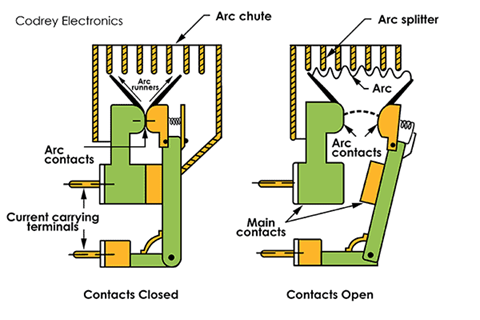
An Air Circuit Breaker (ACB) extinguishes arcs by rapidly increasing the arc's resistance, forcing the arc voltage to exceed the system voltage, and utilizing arc chutes to split and cool the arc at current zero. The process involves splitting, cooling, and stretching the arc using magnetic forces and arc chutes.
Key Mechanisms of Arc Extinction
- High-Resistance Method: The primary technique is to increase the arc resistance rapidly. This is achieved by:
- Lengthening the Arc: The arc path is extended, increasing its resistance, which requires higher voltage to maintain.
- Cooling the Arc: The arc plasma is cooled, reducing the mobility of particles and increasing the resistance.
- Splitting the Arc: The arc is forced into an arc chute, where it is broken down into several smaller, series arcs, causing a rapid voltage drop.
- Arc Chutes (Arc Splitters): ACBs use plates made of insulating materials (like ceramic) to break the arc into smaller segments. This division reduces the energy of the arc and cools it.
- Magnetic Blowout: When a fault occurs, magnetic field coils (or the arc's own magnetic field) force the arc into the arc chutes.
- Air Movement: In some designs, especially Air Blast Circuit Breakers, a, high-velocity stream of compressed air is used to blow the arc into the chutes, cooling it and sweeping away ionized gases.
Working Process Steps
- Contact Separation: During a fault, the contacts separate, drawing an arc.
- Arc Movement: The arc is propelled into the arc chutes, often aided by magnetic blow-out coils.
- Extinction: Inside the chute, the arc is split, lengthened, and cooled until it is extinguished at the current zero point.
Components Involved
- Main Contacts: Carry normal load current.
- Arcing Contacts: Sacrificial, heat-resistant contacts that draw the initial arc.
- Arc Chute/Splitters: Plates that divide and cool the arc.
- Magnetic Blowout Coil: Aids in moving the arc.
ACBs are used primarily in low and medium-voltage applications, often offering the advantage of being resettable.
In an Air Circuit Breaker (ACB), arc extinction is the process of quenching the high-temperature electrical discharge (arc) that forms when the breaker’s contacts separate to interrupt a fault current. Unlike other breakers that use oil or vacuum, the ACB uses atmospheric air as the primary medium to dissipate the arc's energy.
The Working Principle: High Resistance Method
The fundamental principle of arc extinction in an ACB is to rapidly increase the resistance of the arc. As the resistance rises, the voltage required to maintain the arc exceeds the system voltage, causing the arc to extinguish at the next current zero. This is achieved through three primary physical actions:
- Arc Lengthening:
- As the contacts separate, the arc is drawn out. It is then guided by arc runners (horn-shaped conductors) deeper into the quenching chamber.
- Increasing the length directly increases the electrical resistance.
- Arc Splitting:
- The arc is driven into an arc chute containing several metal splitter plates.
- These plates "slice" the single arc into many smaller series arcs. This significantly increases the total "arc voltage" (the minimum voltage needed to sustain the discharge).
- Cooling and De-ionization:
- The large surface area of the metal splitter plates and the surrounding air absorb heat from the arc plasma.
- Cooling reduces the ionization of the air particles, making the path less conductive and helping the arc vanish.
Operational Sequence
- Normal State: Main contacts are closed, carrying the load current.
- Tripping: Upon detecting a fault (like a short circuit), the trip unit triggers the operating mechanism to pull the contacts apart.
- Arc Transfer: To protect the main contacts from heat damage, ACBs use a secondary set of arcing contacts (often made of heat-resistant carbon or copper alloy). The main contacts open first, transferring the current to the arcing contacts, where the actual arc forms.
- Extinction: Electromagnetic and thermal forces push the arc into the arc chute, where it is split, cooled, and extinguished within milliseconds.
Key Variations
- Plain Break ACB: Relies on the natural lengthening of the arc in the open air.
- Magnetic Blowout ACB: Uses magnetic coils to create a field that "blows" the arc into the chutes faster, enhancing efficiency for higher currents.
- Air Blast ACB: Uses a high-pressure jet of compressed air to physically blow out the arc, typically for medium-to-high voltage applications.
|