|
Key Components & Operation of a circuit breaker - Working Principle
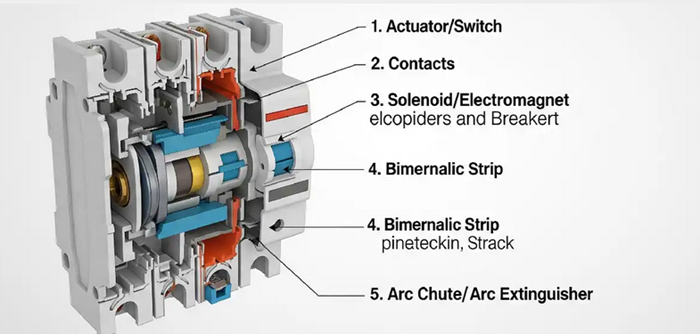
A circuit breaker is an electro-mechanical safety device that automatically interrupts electrical flow during overloads or short circuits to prevent damage. It operates using thermal (bimetallic strip) or magnetic (coil) sensors to trigger contacts to separate, extinguishing the resulting arc via an arc chute, and can be reset manually.
Key Components of a Circuit Breaker
- Frame/Case: Insulated housing that protects internal parts.
- Contacts: Fixed and moving metallic contacts that allow current flow when closed.
- Operating Mechanism: Opens/closes contacts; uses springs or compressed air to store potential energy for rapid operation.
- Trip Unit: Detects fault conditions (overload/short circuit) and triggers the mechanism.
- Thermal (Bimetallic strip): Bends upon overheating due to prolonged overload.
- Magnetic (Electromagnet): Activates instantly during high-current short circuits.
- Arc Extinguisher/Chute: Extinguishes the plasma arc formed during contact separation.
Working Principle
- Normal Condition: Contacts are held together by mechanical pressure, allowing current to flow.
- Fault Detection: When current exceeds rated limits, the trip unit (magnetic coil or thermal strip) acts.
- Opening/Tripping: The trip unit releases the stored energy in the operating mechanism, causing the moving contacts to separate rapidly.
- Arc Extinction: As contacts separate, an electric arc forms in the air gap. The arc chute (extinguisher) breaks this arc, safely stopping the current.
- Resetting: After the fault is cleared, the breaker can be manually switched back on, resetting the mechanism.
A circuit breaker is an automatically operated electrical switch designed to protect a circuit from damage caused by excess current, typically from an overload or short circuit. Unlike a fuse, which must be replaced after one use, a circuit breaker can be reset to resume normal operation.
Key Components
The internal structure of a typical circuit breaker includes five universal parts:
- Frame (Enclosure): The outer shell that provides mechanical support and insulation for internal parts.
- Operating Mechanism: The system of springs and linkages that physically opens or closes the contacts.
- Contacts: Conductive pieces (fixed and moving) that touch to allow current flow and separate to interrupt it.
- Trip Unit: The "brain" of the breaker that senses abnormal conditions and triggers the operating mechanism to open.
- Arc Extinguisher (Arc Chute): A chamber designed to quickly extinguish the electrical spark (arc) that forms when contacts separate under load.
Working Principle & Operation
The circuit breaker operates in three main states:
1. Normal Operation (Closed State)
When the breaker is "ON," the operating mechanism holds the moving contact firmly against the fixed contact. Current flows freely from the incoming terminal, through the internal protection components, to the outgoing terminal.
2. Fault Detection (Tripping)
If current exceeds safe limits, the Trip Unit activates one of two primary mechanisms:
- Thermal Protection (for Overloads): A bimetallic strip heats up and bends gradually due to sustained excess current. Once it bends far enough, it releases the mechanical latch, tripping the breaker.
- Magnetic Protection (for Short Circuits): A sudden, massive surge of current creates a strong magnetic field in an electromagnet (solenoid). This instantly pulls a lever to release the latch and open the contacts within milliseconds.
3. Arc Quenching
As the contacts pull apart, electricity tries to jump the gap, creating a high-temperature electrical arc. To prevent damage, this arc is pushed into arc chutes, where it is split, cooled, and extinguished by a medium such as air, vacuum, oil, or SF6 gas.
Comparison of Arc Quenching Mediums
| Medium |
Application |
Principle |
| Air |
Low Voltage (MCB/MCCB) |
Splits and cools the arc in metal plates. |
| Vacuum |
Medium Voltage |
Rapidly deionizes the gap in a vacuum bottle. |
| SF6 Gas |
High Voltage |
High-pressure gas absorbs heat and extinguishes the arc. |
| Oil |
High Voltage (Older systems) |
Decomposes into hydrogen gas to cool and quench the arc. |
|