|
Plain Break (Cross-Blast) Air Circuit Breakers “Connected” Position - Working Principle
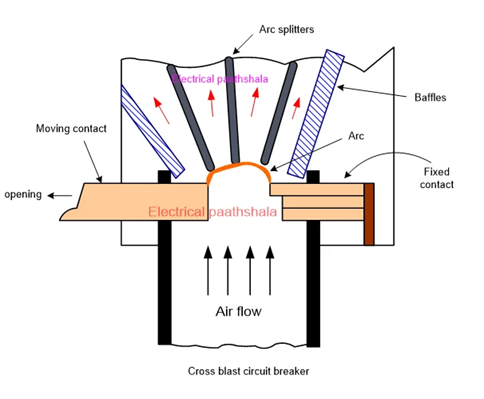
In the "Connected" (closed) position, a Plain Break/Cross-Blast Air Circuit Breaker (ACB) maintains constant contact pressure between fixed and moving contacts via springs, allowing normal operating current flow. Upon detecting a fault, compressed air blasts perpendicular to the opening contacts, forcing the arc into a splitter-filled chute for rapid cooling and extinction.
Working Principle in "Connected" Position
- Normal Operating Condition: In the "Connected" position, the moving contact is firmly held against the fixed contact by springs. Both the main contacts (carrying load) and the auxiliary/arcing contacts (initiating the break) are closed.
- Current Flow: The load current passes through the closed contacts with low resistance.
- The "Cross-Blast" Mechanism: Although the blast is only triggered during disconnection, the "connected" position ensures the contact assembly is aligned with a high-pressure air reservoir, separated by an air valve.
Interruption Process (Upon Trip Signal)
- Contact Separation: The Trip Unit (relay) releases the latch, allowing springs to separate the contacts.
- Arc Formation: As contacts separate, an arc is formed between them.
- Cross-Blast Operation: A high-pressure air valve opens instantly, directing a powerful air blast at right angles (perpendicular) to the path of the arc.
- Arc Extinction: This high-velocity air blast forces the arc into a segmented "arc chute" or "splinter chamber".
- Cooling and De-ionization: The arc is split into smaller segments, rapidly cooled, and extinguished by the high-velocity air, which removes hot, ionized gases.
This process effectively interrupts high fault currents by maximizing the voltage drop across the arc, causing it to die out at the first current zero.
In an Air Circuit Breaker (ACB) system, the "Connected" (or Service) position refers to the operational state where the breaker is fully inserted into its cradle or switchboard compartment.
Working Principle in the Connected Position
When the breaker is in the Connected position, the following electrical and mechanical conditions apply:
- Complete Circuitry: All primary (power), secondary (control/auxiliary), and ground connections are fully made. This allows the breaker to conduct current and respond to remote or automatic trip signals.
- Normal Current Flow: In the "Closed" state while connected, the main contacts (usually made of copper or silver alloy) are held together by spring pressure to carry the load current with minimal resistance.
- Arc Readiness: Even while connected and closed, the arcing contacts (made of heat-resistant copper alloy or carbon) are positioned to take the brunt of any arc that may form during a future opening operation, protecting the main contacts.
- Safety Interlocks: Most modern draw-out ACBs use mechanical interlocks to ensure the breaker cannot be physically moved out of the "Connected" position while the contacts are closed, preventing dangerous arcing at the primary terminals.
Plain Break (Cross-Blast) Mechanism
While "Connected" defines the physical location, the Plain Break (Cross-Blast) principle describes how the breaker will handle a fault from this position:
- Fault Detection: The trip unit senses an overload or short circuit and triggers the operating mechanism.
- Contact Separation: The main contacts open first, followed by the arcing contacts, which draw an electrical arc.
- Cross-Blast Action: A high-velocity stream of air is directed at a right angle (transverse) to the arc.
- Extinction: This "cross-blast" forces the arc into an arc chute containing splitter plates. The arc is lengthened, cooled, and split into smaller segments until the arc voltage exceeds the system voltage, causing it to extinguish at the next current zero.
|




