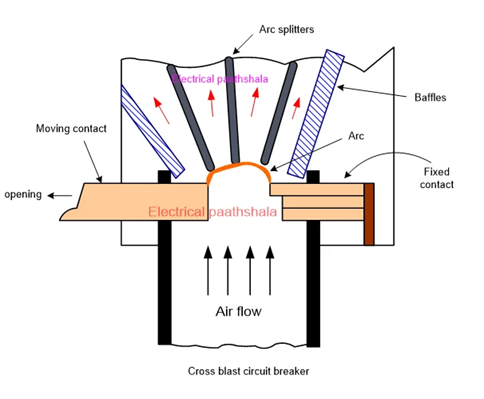
Plain Break (Cross-Blast) Air Circuit Breakers “Test” Position - Working Principle

breaker position

In the "Test" position of a Plain Break (Cross-Blast) Air Circuit Breaker, the main power contacts are physically disconnected from the main busbars, but secondary control circuits remain connected. This allows operators to test the opening/closing mechanisms and electrical controls without energizing the downstream load.

Working Principle in Test Position
  • Physical Isolation: The circuit breaker is withdrawn slightly from the "Service" position, separating the primary (power) disconnects from the main cubicle busbars.
  • Control Continuity: The secondary (auxiliary) plug remains engaged. This allows control power to actuate the closing/tripping coils.
  • Mechanism Testing: The operator can perform close-open tests. While the mechanism operates, no arc is produced in the arc chutes because the main circuits are not connected to any power source.
  • Safety: The "Test" position ensures maintenance personnel can verify control logic and operation securely without risk of high-voltage faults, often enforced by interlocks that prevent closing in this position if the main power were still connected.
Cross-Blast (Plain Break) Arc Extinction Principles (Operational context)
  • Mechanism: When the breaker operates (in service), a high-pressure blast of air is forced perpendicularly across the arc path as contacts separate.
  • Arc Quenching: The air blast rapidly cools the arc, lengthening it into arc chutes, increasing its resistance, and leading to extinction.
  • Design: Plain break types often use arc chutes with splitter plates to divide and cool the arc, relying on air for insulation and cooling.
  1. The "Test" Position Principle
    The fundamental principle of the Test position is the selective connection of internal circuits:
  • Primary Disconnects (Power): These are physically separated from the main cubicle busbars. The breaker is effectively "off-grid," so closing the contacts will not energize any downstream equipment.
  • Secondary Disconnects (Control): These remain fully connected. This provides the necessary electrical power to the closing coils, trip units, and auxiliary switches.
  1. Working Mechanism in "Test" Mode
    When the breaker is moved to this position via the racking mechanism:
  • Operational Check: You can electrically or manually operate (Open/Close) the breaker to verify that the operating mechanism functions correctly without the risk of handling high-power currents.
  • Safety Interlocks: Most modern units include racking interlocks that prevent the breaker from being moved between positions while the contacts are closed, ensuring no accidental arcing occurs during transition.
  • Charging: If equipped with an electric motor, the closing springs can be charged automatically in this position to prepare for a functional test.
  1. Connection to Cross-Blast Principle
    While the "Test" position relates to the breaker's physical location in the cubicle, the Cross-Blast principle defines how it handles a real fault:

Normal Operation: A high-pressure air blast is directed perpendicularly (cross-wise) to the arc formed between contacts.
In "Test" Position: Since the primary power is disconnected, no arc is formed during operation. This allows technicians to confirm that the mechanical "blast" valves or arc chute alignment is ready for actual service without the heat and stress of an electrical arc.

favicon bacd

+(39) 347 051 5328

Italy - Kazakhstan

09.00am to 18.00pm

About

We offer the best and economical solutions, backed by 27+ years of experience and international standards knowledge, echnological changes, and industrial systems.

Marketing Materials

Spring Renovation
Industry
US Gas Company
Construct
Plus Project
Vam Drilling Service
X Project
X Project
Cabrrus Training

Marketing Materials1

Spring Renovation
Industry
US Gas Company
Construct
Plus Project
Vam Drilling Service
ultrasonic sensor
ultrasonic sensor
Cabrrus Training