|
Magnetic Blowout Air Circuit Breakers - Working Principle
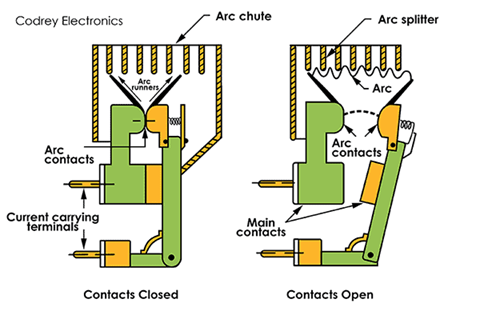
Magnetic blowout air circuit breakers (ACBs) extinguish arcs by using current-carrying coils to generate a magnetic field that forces the arc into arc chutes. As contacts separate, the arc is stretched, cooled, and split into smaller segments by metal plates, accelerating extinction in under a second for voltages up to 11kV.
Core Working Principle
- Arc Formation: Upon separating contacts during a fault, an electrical arc forms between them.
- Magnetic Field Generation: The arc current flows through "blowout coils" (series trip coils), creating a strong magnetic field.
- Arc Extension & Movement: This magnetic field interacts with the arc (Lorentz force), propelling it upward into the arc chutes.
- Arc Extinction: Inside the arc chutes, the arc is lengthened, cooled, and divided by metal splitter plates, causing it to lose energy and vanish.
Key Components & Features
- Arc Chutes: Metal plates that break the arc into smaller pieces for faster, efficient cooling.
- Blowout Coils: Electromagnets that generate the force to move the arc.
- Applications: Primarily used for protecting industrial, low-voltage power systems and high-current circuits (up to 11kV).
Compared to other ACBs, the magnetic blowout type provides significantly faster, more controlled arc interruption.
Magnetic Blowout Air Circuit Breakers (ACBs) use electromagnetic forces to rapidly extinguish the electrical arc that forms when contacts separate under load or fault conditions. This type is primarily used for industrial applications with voltages up to 11kV.
Working Principle
The core operation follows a specific sequence of magnetic and thermal actions:
- Fault Detection & Initiation: When a fault (like a short circuit) is detected, the trip unit signals the operating mechanism to pull the contacts apart.
- Arc Formation: As the contacts separate, an electrical arc is drawn between them through the surrounding air.
- Magnetic Blowout Action
- The current flowing through the breaker passes through blowout coils connected in series.
- This current generates a powerful magnetic field that interacts with the arc's own magnetic field (Lorentz force).
- This force "blows" or drives the arc upwards and away from the contacts.
- Arc Stretching & Splitting
- The magnetic field forces the arc into an arc chute—a chamber containing several metal arc splitter plates.
- Inside the chute, the arc is stretched in length, which increases its electrical resistance.
- The metal plates split the single arc into multiple smaller segments, which significantly raises the total arc voltage.
- Extinction: The increased resistance and rapid cooling by the splitter plates cause the arc voltage to exceed the system voltage, causing the arc to extinguish at the next current zero-crossing.
Key Benefits
- Faster Quenching: The magnetic force accelerates arc movement into the cooling chamber faster than natural thermal buoyancy alone.
- High Breaking Capacity: It can handle heavy fault currents more effectively, as the "blowout" force increases with the current magnitude.
- Contact Protection: By moving the arc away quickly, it minimizes erosion on the main contacts, extending the breaker's lifespan.
|