|
Air Chute Air Circuit Breakers (ACBs) - Working Principle
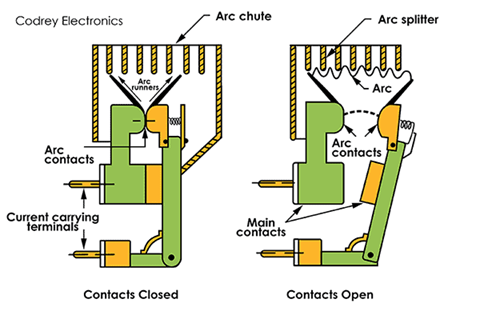
Air Chute Air Circuit Breakers (ACBs) work by extinguishing electric arcs formed during contact separation in low or medium voltage circuits using surrounding air. When contacts open, an arc is formed and pushed by magnetic force into arc chutes—metallic splitter plates—which divide, elongate, cool, and extinguish the arc in milliseconds.
Core Working Principle
- Initial Fault Detection: Under fault conditions (overload or short circuit), the ACB's operating mechanism initiates contact separation.
- Arc Formation: As the main contacts separate, an electric arc forms between them.
- Arc Movement & Splitting: The arc is drawn into the arc chute, a chamber containing several metal plates. These plates split the single, high-energy arc into a series of smaller, cooler arcs.
- Extinction: The air inside the chutes, combined with the cooling effect of the metallic plates, increases the arc's resistance, causing it to lose energy and extinguish quickly.
Components and Mechanisms
- Arc Runners/Chutes: They guide the arc into the splitter plates, breaking it into smaller pieces.
- Magnetic Blowout Coil: In many designs, this coil creates a magnetic field that forces the arc into the chute, ensuring rapid extinction.
- Main and Arcing Contacts: The main contacts carry the current, while arcing contacts (designed for high temperatures) manage the arc, protecting the main contacts.
- Air Medium: The ambient air surrounding the arc serves as the interrupting medium to dissipate heat.
These breakers are widely used for low-voltage power distribution, providing a safe way to interrupt, break, and protect electrical circuits.
The working principle of an Air Chute Air Circuit Breaker (ACB) centers on using atmospheric air to increase the electrical resistance of an arc until the system's voltage can no longer maintain it. Unlike oil or vacuum breakers, these devices operate by physically manipulating the arc to cool and dissipate its energy.
Core Working Mechanism
When a fault (such as an overload or short circuit) is detected by the trip unit, the operating mechanism triggers the separation of the contacts.
- Arc Formation: As the contacts pull apart, the high voltage ionizes the surrounding air, creating a conductive, high-temperature "arc".
- Contact Protection: Most ACBs use two sets of contacts:
- Main Contacts: Made of silver-plated copper for low resistance during normal operation.
- Arcing Contacts: Made of heat-resistant copper alloy. They open last and close first, taking the brunt of the arc damage to preserve the main contacts.
- Arc Movement: The arc is driven upward away from the contacts by thermal buoyancy and electromagnetic forces. In some models, magnetic blowout coils generate a field that "pushes" the arc even faster into the chute.
- The Arc Chute (Extinction): The arc enters the arc chute, a chamber filled with insulated splitter plates. This component extinguishes the arc through:
- Splitting: The plates divide the large arc into several smaller segments in series.
- Lengthening: The zigzag path within the chute increases the arc's length.
- Cooling: The large surface area of the metal plates absorbs heat, reducing the temperature and de-ionizing the air.
- Interruption: These factors combined significantly increase the arc resistance. When the voltage drop across the arc exceeds the supply voltage, the arc is extinguished, and current flow stops.
Typical Applications
- Low to Medium Voltage: Generally used in systems from 400V to 15kV.
- Industrial Settings: Commonly found in LT (Low Tension) Panels, main distribution boards, and power plants to protect motors and transformers.
|