|
Protection Functions of a Circuit Breakers - Working Principle
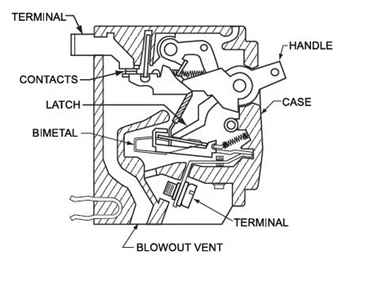
Circuit breakers are electromechanical safety devices that protect electrical circuits from damage by automatically interrupting current flow during overloads or short circuits. They function as automatic switches using thermal (bimetallic strip) for long-term overloads and magnetic (electromagnetic coil) principles for instant, high-current short circuit protection.
Key Protection Functions & Working Principles
- Overload Protection (Thermal): A bimetallic strip heats up and bends when excess current flows for an extended period, triggering the mechanism to break the circuit.
- Short Circuit Protection (Magnetic): A high, instant surge in current activates an electromagnet, pulling a plunger that immediately breaks the circuit, preventing fire or equipment damage.
- Manual Switching: They act as a switch to manually open or close the circuit for maintenance.
Working Mechanism
Under normal conditions, contacts are held closed by springs. When a fault occurs (overload/short), the thermal or magnetic mechanism trips the operating mechanism, separating the contacts and extinguishing the arc to stop the current flow. Unlike fuses, they can be reset.
Circuit breakers act as automatic switches that protect electrical systems by interrupting power flow when a fault occurs. Modern breakers typically utilize a thermomagnetic design to provide two distinct types of protection.
- Overload Protection (Thermal)
- Purpose: Protects against sustained currents that slightly exceed the circuit's rated capacity (e.g., plugging too many appliances into one outlet).
- Working Principle: It uses a bimetallic strip made of two different metals bonded together. As current flows through the strip, it generates heat. Excessive current causes the metals to expand at different rates, forcing the strip to bend.
- Tripping Action: Once the strip bends sufficiently, it strikes a trip latch that releases the spring-loaded contacts, opening the circuit. This process is intentionally time-delayed to allow for brief, harmless surges like a motor starting up.
- Short Circuit Protection (Magnetic)
- Purpose: Protects against sudden, massive surges of current caused by a direct connection between a "hot" wire and a neutral or ground wire.
- Working Principle: It uses an electromagnetic coil (solenoid). Under normal conditions, the magnetic field is weak. However, a short circuit causes the current to spike instantly to thousands of amps.
- Tripping Action: This massive current creates a powerful magnetic field that instantly pulls a plunger or armature. The plunger strikes the trip bar, forcing the contacts apart in milliseconds—much faster than the thermal mechanism.
- Advanced Protection Functions
Some specialized breakers provide additional safety features:
- Ground Fault Protection (GFCI): Monitors the balance between the "hot" and "neutral" wires. If it detects a tiny imbalance (as low as 4-6 mA), it assumes electricity is leaking to the ground (potentially through a person) and trips instantly to prevent electrocution.
- Arc Fault Protection (AFCI): Uses advanced electronics to recognize the unique signature of an electrical arc (sparking caused by damaged or loose wiring). It trips to prevent fires before the heat can ignite surrounding materials.
Would you like to see a comparison between residential MCBs and industrial MCCBs regarding their adjustable trip settings?
|