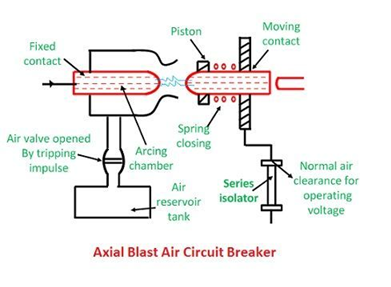
Air Blast Circuit Breakers - Working Principle

blast circuit

Air blast circuit breakers (ABCB) use a high-pressure air blast (typically 20-30 kg/cm²) to extinguish electrical arcs formed during contact separation, acting within ~40 ms. When a fault occurs, compressed air from a reservoir is released through nozzles, cooling and sweeping away ionized gases, forcing the arc to extinguish at current zero. 

Key Working Principles

  • Arc Initiation: When the circuit breaker operates under fault conditions, the moving contacts separate, creating an arc between the contacts due to air ionization.
  • Air Blast Activation: Simultaneously, a blast valve opens, allowing compressed air to flow at high velocity directly into the arcing zone.
  • Arc Extinction: The high-velocity air blast increases the arc's resistance by cooling it and replacing the ionized air with fresh air, forcing the arc to quench at the next current zero.
  • Types of Airflow:
    • Axial Blast: Air flows parallel to the arc path.
    • Radial Blast: Air flows radially across the arc.
    • Cross Blast: Air flows perpendicular to the arc path.
Advantages:
  • Fast Operation: Ideal for high-speed fault clearing.
  • Reduced Risk: No fire hazards compared to oil circuit breakers.
  • Low Maintenance: Less carbonization due to air as the medium.
Disadvantages:
  • Noise: Significant noise pollution during operation.
  • Complexity: Requires a, constant supply of high-pressure air and compressors.
  • Current Chopping: Potential issues with premature current interruption.
Air blast circuit breakers are generally replaced by SF6 circuit breakers in modern, high-voltage applications.
The working principle of an Air Blast Circuit Breaker (ABCB) centers on using a high-velocity jet of compressed air to rapidly extinguish the electric arc formed when contacts separate during a fault.
 
Core Working Principle
  1. Fault Detection: When a fault (such as a short circuit) occurs, the protection system sends a tripping signal to the breaker.
  2. Blast Valve Opening: This signal triggers a pneumatic operating mechanism that opens a blast valve, releasing air stored in a high-pressure reservoir (typically 20–30 bar).
  3. Contact Separation: The high-pressure air enters the arc extinction chamber and exerts force on the moving contact, pushing it away from the fixed contact.
  4. Arc Quenching: As the contacts separate, an electric arc forms. The high-velocity air blast then:
    • Cools the arc by rapidly absorbing and carrying away heat.
    • Sweeps away ionized particles that sustain the current flow, replacing them with fresh, non-conductive air.
    • Increases dielectric strength of the gap so rapidly that the arc cannot restrike after the first current zero.

Main Types by Blast Direction

  • Axial Blast: The air flows longitudinally along the arc path. It is the most common type for high-voltage applications.
  • Cross Blast: The air is directed at a right angle (90°) to the arc, forcing it into arc splitters and chutes to lengthen and cool it.
  • Radial Blast: The air is admitted radially into the gap and then flows axially, often used in double-blast configurations for extra-high voltage.
Key Components
  • Air Reservoir: Stores the compressed air needed for operation.
  • Hollow Insulator: Provides a path for high-pressure air while isolating live parts from the ground.
  • Arc Extinction Chamber: The housing where contact separation and arc quenching actually occur.
  • Series Isolator: Often included in axial types to provide additional clearance after the small contact gap has successfully interrupted the current.

favicon bacd

+(39) 347 051 5328

Italy - Kazakhstan

09.00am to 18.00pm

About

We offer the best and economical solutions, backed by 27+ years of experience and international standards knowledge, echnological changes, and industrial systems.

Marketing Materials

Spring Renovation
Industry
US Gas Company
Construct
Plus Project
Vam Drilling Service
X Project
X Project
Cabrrus Training

Marketing Materials1

Spring Renovation
Industry
US Gas Company
Construct
Plus Project
Vam Drilling Service
ultrasonic sensor
ultrasonic sensor
Cabrrus Training