|
Shunt trip circuit breaker operation
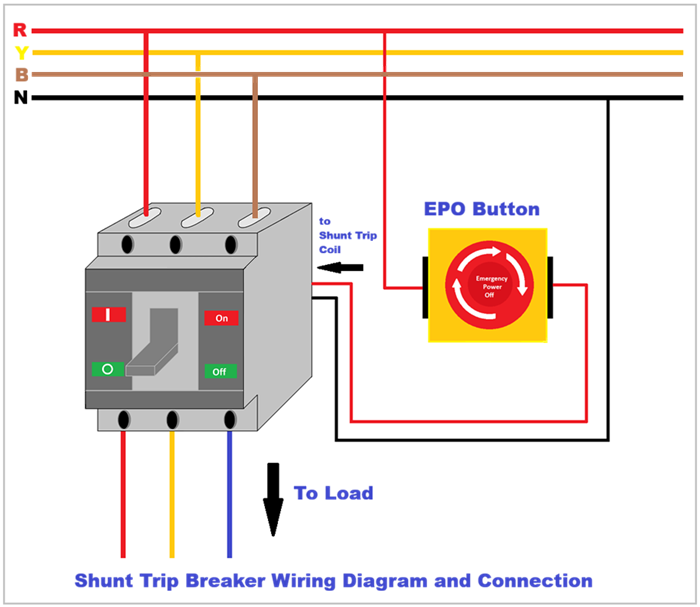
A shunt trip circuit breaker operates by using an internal electromagnetic coil (solenoid) to mechanically trip the breaker when an external voltage signal is applied, allowing for remote or automatic, instantaneous power disconnection. It acts as a safety accessory, enabling emergency shutdowns via smoke detectors, fire alarms, or manual buttons.
Key Principles and Components
- Electromagnetic Mechanism: The core component is a shunt coil, which is a small solenoid installed inside the breaker.
- External Triggering: Unlike standard breakers that trip on internal overcurrent, a shunt trip responds to an external voltage source (e.g., 24V DC, 120V AC, 240V AC) applied to its terminals.
- Operation: When the external voltage signal is received, the shunt coil is energized, generating a magnetic field. This field pulls an armature, which mechanically trips the breaker latch, opening the main contacts and cutting power.
- Configuration: It is often an add-on accessory for MCBs, MCCBs, and ACBs.
Applications
Emergency Shutdowns: Remotely shutting down machinery via a panic button.
Fire Safety Systems: Automatically cutting power to air handling units or equipment upon smoke detection.
Elevator Control: Interlocking with fire alarms to recall elevators.
Unlike an undervoltage release, a shunt trip requires voltage to be applied to trip the breaker, rather than losing voltage to trigger it.
A shunt trip is an accessory that adds remote control to a standard circuit breaker. While normal breakers trip automatically due to internal faults like overloads, a shunt trip allows you to force the breaker open using an external signal.
Core Working Principle
The mechanism functions as an electromechanical "remote control" for the breaker's internal latch.
- Standby State: Under normal conditions, the shunt trip's electromagnetic coil is de-energized. The breaker functions as a standard protective device, staying closed unless an internal overcurrent or short circuit occurs.
- Activation Signal: An external device (like a fire alarm or emergency stop button) sends a voltage pulse to the shunt trip terminals.
- Electromagnetic Force: This voltage energizes the internal coil, creating a magnetic field that pulls an internal plunger or armature.
- Mechanical Trip: The moving plunger strikes the breaker's trip lever, physically releasing the main latch and snapping the contacts open.
- Circuit Interruption: The power is cut instantly (typically within 20–50 milliseconds), regardless of the current load.
Key Technical Details
- External Power Needed: Unlike standard trips, the shunt trip requires its own external power source (e.g., 24V DC or 120V AC) to energize the coil.
- Manual Reset Required: Once a shunt trip is activated, the breaker cannot be reset remotely. A person must physically go to the panel, clear the signal, and flip the handle to "Off" and then "On".
- Short Duty Cycle: The coils are generally designed for intermittent use. Keeping voltage on the coil for too long (over 1 second) can cause it to burn out, so many systems include a cut-off switch to protect the coil once the breaker opens.
Common Applications
- Fire Safety: Interfacing with fire suppression systems to cut power before water sprinklers activate.
- Emergency Stop (EPO): Providing a fast way to shut down industrial machinery or entire data centers from a centralized button.
- Solar PV Systems: enabling rapid shutdown of DC power during faults or emergencies.
|




