|
Capacitive Load Banks - Working Principle
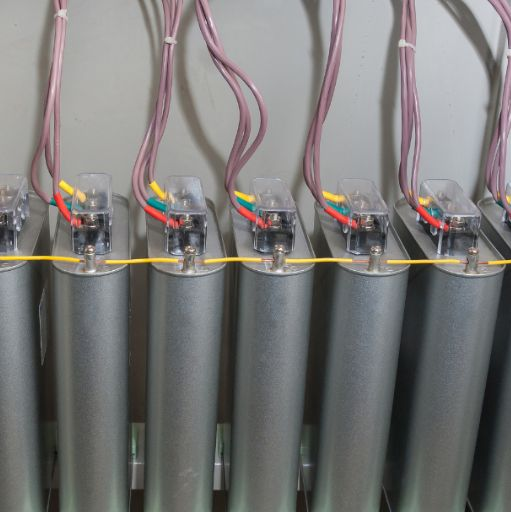
Capacitive load banks simulate, test, and verify power systems by creating a leading power factor, supplying reactive power (kVAr) to counteract inductive loads. Used in UPS, data center, and telecommunications testing, they ensure system stability, correct power factors to near unity, and prevent over-excitation in generators. For more details click here
Key Aspects of Capacitive Load Banks
- Function: They simulate capacitive loads that draw leading current (current leads voltage), essential for testing equipment that creates lagging power factors.
- Components: These units contain industrial-grade capacitors and, in portable units, safety discharge resistors to remove DC charge after use.
- Applications:
- Commissioning & Testing: Testing generators, uninterruptible power supplies (UPS), and inverters to ensure they can handle reactive loads.
- Power Factor Correction: Used to offset inductive loads (motors/transformers) in factories or data centers.
- Voltage Regulation: Helps maintain stable voltage levels in electrical systems.
- Rating & Control: They are typically rated in kilovolt-amperes reactive (kVAr) and feature controls to adjust the load amount.
- Combined Testing: Often used in conjunction with resistive load banks to create a specific, combined power factor test.
Capacitive load banks are essential for ensuring the reliability of electronic, non-linear loads.
A capacitive load bank is a specialized testing device that uses capacitors to simulate electrical loads with a leading power factor. Unlike standard resistive load banks that convert energy into heat, capacitive load banks store and release electrical energy in an electric field.
Core Functionality
- Leading Power Factor: They cause the circuit current to peak before the voltage in each electrical cycle.
- Reactive Power: They supply reactive power (measured in kVAr) back to the system rather than consuming it.
- System Correction: When used alongside inductive loads (like motors), they bring the overall power factor closer to unity (1.0), improving efficiency.
Common Applications
Capacitive load banks are essential for testing modern infrastructure that handles non-linear or electronic loads.
- Data Centers: Simulating the fluctuating capacitive loads of servers and switching power supplies.
- UPS Systems: Verifying the stability of Uninterruptible Power Supply (UPS) inverters under leading power factor conditions.
- Renewable Energy: Testing solar inverters and wind turbine converters to ensure they can manage grid abnormalities (anti-islanding).
- Marine Engineering: Commissioning shipboard power systems that increasingly rely on inverters and battery packs.
- Industrial Facilities: Providing power factor correction to reduce electricity bills by counteracting inductive loads from motors and transformers.
Key Specifications
| Feature |
Description |
| Rating Unit |
Kilo Volt-Ampere reactive (kVAr). |
| Safety Features |
Overvoltage/overcurrent protection and high-value discharge resistors to drain residual charge. |
| Control |
Often feature microprocessor-based controls for precise load steps (e.g., as small as 1 kVAr). |
| Configuration |
Can be portable for field testing or fixed for permanent R&D installations. |
Comparison of Load Bank Types
| Load Type |
Phase Relationship |
Primary Use |
| Resistive |
Current and voltage in phase |
Testing engine capacity (kW) and fuel systems. |
| Inductive |
Current lags voltage |
Simulating motors, transformers, and HVAC systems. |
| Capacitive |
Current leads voltage |
Simulating computer loads and power factor correction. |
For comprehensive validation, facilities often use Resistive-Reactive (Combined) load banks, which integrate all three elements to match a facility's actual electrical profile.
|