Pulse Testing of Battery

pulse battery

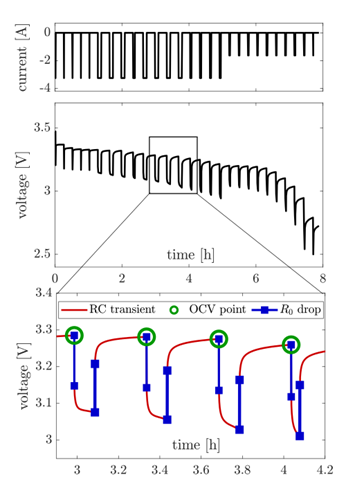
Pulse testing of a battery is a dynamic diagnostic method that applies short, high-current pulses to evaluate a battery's condition under stress, rather than just measuring resting voltage. It simulates real-world, high-demand applications (like engine cranking or motor acceleration) to determine capacity, internal resistance, and state of health (SOH).

Key Aspects of Pulse Testing
  • Purpose: It measures the battery's ability to maintain voltage while under stress, rather than just measuring raw voltage, which indicates actual capacity.
  • Mechanism: A pulse load tester briefly draws a high current (similar to a starter motor) and monitors the voltage drop and recovery.
  • Key Techniques:
  • Parameters Tested:
    • State of Health (SOH): Determines aging, often caused by sulfation.
    • Internal Resistance (IR): Higher resistance means lower performance, especially during high-demand events.
    • Voltage Recovery: A healthy battery recovers quickly from a pulse; a weak one is sluggish.
    Benefits of Pulse Testing
    • "Real World" Simulation: Mimics actual operating conditions better than simple voltage checks.
    • Speed: Provides rapid assessment of battery condition.
    • Application: Ideal for electric vehicle batteries, hybrid vehicles, grid storage, and consumer electronics.
    • Diagnostic Tools: Uses specialized equipment that indicates results, often with LED lights indicating "Strong" (green), "Weak" (yellow), or "Fail" (red).

    Key Types of Pulse Testing

    Why Use Pulse Testing?

    1. Internal Resistance (DCIR) Calculation: By measuring the instantaneous voltage drop (ΔV) at the onset of a pulse and the current change (ΔI), engineers calculate the Direct Current Internal Resistance (R = ΔV  / ΔI ).
    2. State of Health (SOH) Assessment: Monitoring how quickly a battery voltage recovers after a pulse (recovery time) can indicate aging or sulfation in lead-acid batteries.
    3. Real-World Simulation: It tests the battery's ability to handle high-drain devices (like power tools or e-cigarettes) where current is drawn in 1- to 10-second pulses rather than continuously.
    4. Battery Recovery: "Pulse repair" chargers use high-frequency pulses to break down sulfate crystals on the plates of older lead-acid batteries to restore capacity.

      favicon bacd

      +(39) 347 051 5328

      Italy - Kazakhstan

      09.00am to 18.00pm

      About

      We offer the best and economical solutions, backed by 27+ years of experience and international standards knowledge, echnological changes, and industrial systems.

      Marketing Materials

      Spring Renovation
      Industry
      US Gas Company
      Construct
      Plus Project
      Vam Drilling Service
      X Project
      X Project
      Cabrrus Training

      Marketing Materials1

      Spring Renovation
      Industry
      US Gas Company
      Construct
      Plus Project
      Vam Drilling Service
      ultrasonic sensor
      ultrasonic sensor
      Cabrrus Training