|
AC Internal Resistance (AC-IR)
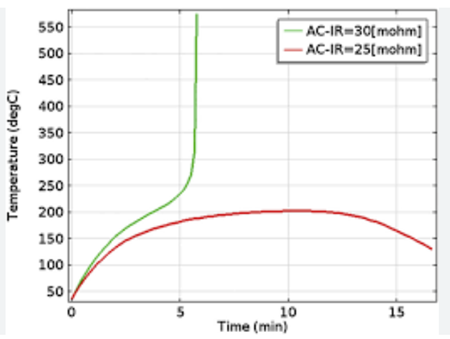
AC Internal Resistance (AC-IR) is a key battery health parameter measured using a high-frequency (typically 1kHz) AC signal to determine ohmic resistance, excluding electrochemical reaction delays. It acts as a reliable, rapid indicator of battery degradation and degradation-induced heat, usually measured in milliohms (mΩ).
- Definition: AC-IR measures the resistive component of the total impedance, which includes electrical resistance (materials) and ionic resistance (electrolyte).
- 1 kHz Standard: Most chargers and battery testers use a
AC signal, which ignores Capacitive and Inductive effects, focusing on the purely ohmic resistance.
- Purpose: It is primarily used as a diagnostic tool to assess the "State of Health" (SoH). A low AC-IR indicates a healthy battery, while rising values signify aging, degradation, or damage.
- AC-IR vs DC-IR: AC-IR is faster and measures immediate, Ohmic, high-frequency resistance. DC-IR (Direct Current Internal Resistance) requires a heavy load pulse to measure total resistance, including slow chemical diffusion factors.
- Importance: A lower internal resistance allows for higher current delivery without excessive voltage drops or heat generation.
- Factors Affecting AC-IR: The value depends on temperature, state of charge (SOC), and battery aging (formation of solid electrolyte interphase).
Key Characteristics of AC-IR
- Speed & Efficiency: The test is extremely fast, often taking only milliseconds, making it the industry standard for mass-production quality control and battery cell sorting.
- Measurement Focus: At 1 kHz, the test primarily measures the ohmic resistance (the resistance of the physical materials like tabs, collectors, and electrolyte). Because the frequency is high, it "shorts out" capacitive effects, effectively bypassing slower chemical processes like polarization and diffusion.
- Health Indicator: AC-IR is a highly reliable "snapshot" of a battery's State of Health (SoH). An increase in AC-IR over time indicates degradation, such as the thickening of the Solid Electrolyte Interphase (SEI) layer.
AC-IR vs. DC-IR
| Feature |
AC-IR (AC Impedance) |
DC-IR (DC Resistance) |
| Signal Type |
1 kHz AC sine wave |
High-current DC pulse |
| Duration |
Milliseconds |
Seconds (1–10s) |
| Includes |
Pure ohmic resistance |
Ohmic + Polarization + Diffusion |
| Use Case |
Fast sorting & quality checks |
Real-world power performance |
| Typical Value |
Generally lower (approx. 70% of DC-IR) |
Generally higher |
Why It Matters
- Energy Loss: Higher internal resistance converts electrical energy into heat rather than power, which can lead to overheating and reduced battery life.
- Voltage Sag: High resistance causes the voltage to drop sharply under load, which may cause devices to shut down prematurely even if the battery has capacity remaining.
For precise diagnosis, professional battery testers or chargers (like the XTAR Dragon) often use a 4-wire (Kelvin) measurement method to eliminate the resistance of the test leads themselves.
|




