|
Constant Resistance (CR) mode
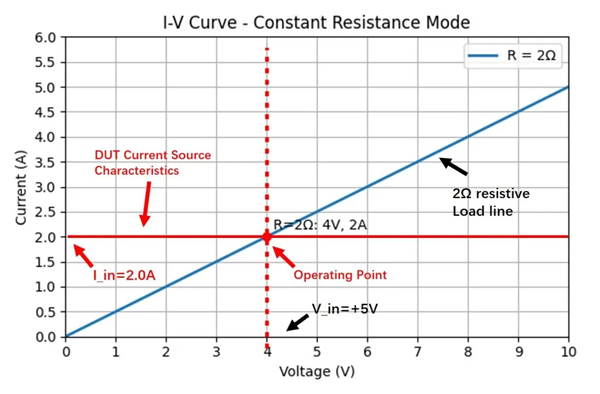
In electronics and testing, Constant Resistance (CR) mode is a setting on electronic loads or a method of discharging a battery where the load behaves like a fixed resistor (R = V / I ). Unlike Constant Current (CC) mode, where the amperage stays the same regardless of voltage drop, in CR mode, the current decreases proportionally as the battery voltage drops.
Here is an overview of Constant Resistance in battery testing:
What is Constant Resistance Mode?
- Definition: The electronic load maintains a fixed ratio between input voltage and input current ( V/I is constant).
- Behavior: As the battery discharges, its voltage drops, causing the current drawn by the load to also drop linearly.
- Simulation: This mode simulates real-world resistive loads, such as heaters, light bulbs, or simple electronic circuits, making it ideal for testing battery life under these specific conditions.
Key Features and Applications
- Capacity Testing: CR is used to evaluate battery capacity, specifically assessing how much energy the battery can deliver under a set resistive load.
- Starting Conditions: CR is frequently used to measure the start-up behavior of electronic devices.
- Power Electronics: It is useful for testing devices with a defined source resistance, such as LED drivers or motor controllers.
- Startup Protection: When testing switching power supplies, CR mode is often preferred over CC mode because it allows voltage and current to ramp up together, preventing the power supply from overloading.
Advantages and Limitations
- Pros: Simulates real-world conditions (non-constant current) and allows for accurate measurement of peak loading conditions.
- Cons: Because the current drops as the voltage decreases, the test can be more complex to interpret than a simple constant current discharge, as the discharge curve is not linear.
Difference Between CC and CR Modes
| Feature |
Constant Current (CC) |
Constant Resistance (CR) |
| Current |
Stays constant |
Drops as voltage drops |
| Resistance |
Changes |
Stays constant |
| Primary Use |
Standard Capacity (Ah) tests |
Real-world load simulation |
Note: In the context of batteries, "CR" is sometimes confused with "CR2032" (a 3-volt Lithium Manganese Dioxide battery). However, in testing, it refers to the operating mode of the equipment.
Potential Confusions
- CR Battery Labeling: If you see "CR" on a battery (e.g., CR2032), it does not stand for "Constant Resistance." In the IEC standard nomenclature, "C" stands for Lithium Manganese Dioxide chemistry, and "R" stands for Round (cylindrical or button) shape.
- Internal Resistance: This refers to the battery's own opposition to current flow, which increases as the battery ages or discharges.
For precise testing, engineers often use specialized DC Electronic Loads that can be programmed to Constant Resistance mode.
|




