|
Closed-Loop Communication (Active)
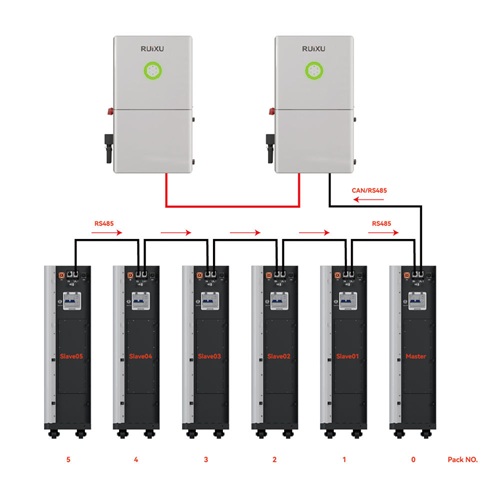
Closed-loop communication (or "active" communication) is a digital, two-way, real-time data link between a battery’s Management System (BMS) and an inverter-charger. Unlike open-loop systems that rely on fixed settings, the BMS actively tells the inverter its exact limitations, allowing the inverter to adjust charge/discharge rates, voltage, and manage SoC dynamically.
Core Parameters Communicated
- State of Charge (SoC): Provides an exact percentage, preventing inaccurate readings that occur with voltage-only (open-loop) monitoring.
- Voltage Limits: Defines the safe operating window for the battery to prevent overcharging or undercharging.
- Maximum Charge/Discharge Current: The BMS tells the inverter how many amps it can handle, automatically reducing current when the battery is almost full or if it becomes too hot/cold.
- Battery Status: Transmits temperature, cell health, and alarms.
How It Works
Unlike "open-loop" systems where the inverter merely guesses battery status based on voltage, a closed-loop system uses a physical data link (typically CAN bus or RS485/Modbus) to send real-time commands:
- Dynamic Limits: The BMS calculates and sends the currently allowed maximum charge and discharge current based on cell temperature and health.
- Precise SoC: The inverter receives an exact State of Charge (SoC) percentage directly from the BMS, eliminating the inaccuracies of voltage-based estimation.
- Safety Commands: If a cell reaches a critical limit (e.g., over-temperature or over-voltage), the BMS instructs the inverter to stop immediately before a hardware disconnect is required.
Benefits of Closed-Loop Communication
- Optimized Performance & Safety: The battery never operates outside its optimal parameters, significantly extending its lifespan and reducing fire risks.
- Faster Charging: Allows for higher, safe charging currents (up to 25–40% faster) compared to conservative, fixed, open-loop settings.
- Easier Installation: Eliminates the need for manual, complex programming of charge voltages and current limits, as the inverter receives them automatically.
- Dynamic Cell Balancing: Helps the BMS manage cell balancing at the end of a charge cycle, preventing individual cells from overvoltage.
Key Benefits
Common Communication Protocols
- CAN bus: The most common protocol for high-performance lithium systems.
- Modbus (RS485): A common, reliable, machine-to-machine language for smart communication.
Closed-Loop vs. Open-Loop
| Feature |
Closed-Loop (Active) |
Open-Loop ("Dumb" Battery) |
| Communication |
Two-way (Real-time data) |
None or One-way (Voltage only) |
| Charge Control |
Dynamically adjusted by BMS |
Manually set by installer |
| SoC Accuracy |
Very High (direct from BMS) |
Often inaccurate |
| Safety |
High (Immediate intervention) |
Moderate (Requires manual settings) |
| Battery Life |
Optimized (Longer) |
Moderate (Requires manual settings) |
Closed-loop communication is critical for modern lithium iron phosphate (LiFePO4) systems to ensure safety and efficiency
Common Compatible Brands
|




