|
Contactors Electromechanical switches start/stop motors - Worlking Principle
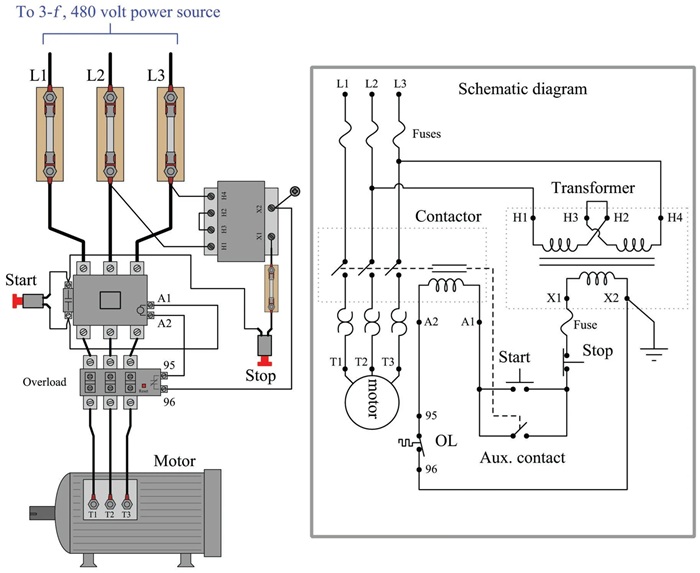
Contactors are heavy-duty, electromechanical switches used to safely start and stop high-power electrical loads, primarily electric motors, using a low-power control signal. They work on the principle of electromagnetism: energizing an internal coil creates a magnetic field that forces contacts together, completing the circuit to the motor.
Working Principle
The operation of a contactor is based on converting electrical energy into magnetic energy to produce mechanical motion.
- Energizing the Coil (Start): When an operator presses a "Start" button, a small control voltage (e.g., 24V DC or 120V AC) is applied to the electromagnetic coil (terminals A1 and A2).
- Creating a Magnetic Field: The current flowing through the coil generates a strong magnetic field in the iron core.
- Moving the Armature: This magnetic force attracts a movable iron piece, known as the armature, dragging it down towards the fixed core.
- Closing the Contacts: The movement of the armature causes the main power contacts (L1, L2, L3) to snap shut, connecting the high-voltage power supply to the motor terminals (T1, T2, T3).
- De-energizing the Coil (Stop): When the "Stop" button is pressed, the control voltage to the coil is cut. The magnetic field disappears.
- Spring Return: A mechanical spring pushes the armature back to its original position, separating the contacts and instantly breaking the power supply to the motor.
Key Components
- Electromagnetic Coil: The "brain" of the contactor that creates magnetism when energized.
- Armature: A movable iron piece that links the coil to the contacts.
- Contacts: Conductive silver alloy contacts (fixed and moving) that bridge the circuit to carry high-current power.
- Return Spring: Ensures the contacts open rapidly when the coil is de-energized.
- Arc Chutes (Arc Suppression): Special chambers that extinguish the high-voltage sparks (arcs) produced when the heavy-load contacts open, preventing damage.
- Auxiliary Contacts: Smaller, low-power contacts used for control, feedback, or interlocking (e.g., to keep the motor running after the start button is released).
Key Differences: Contactors vs. Relays
While both are electromagnetically operated, they are used for different purposes:
- Contactors are built for high-current (usually >10A) and high-voltage applications, such as motors and industrial heating.
- Relays are used for low-current signals and control logic.
Advantages in Motor Control
- Remote Operation: Allows starting/stopping large motors from a safe, distant location.
- Safety: Isolates the operator from high-voltage circuits.
- High-Current Handling: Designed to manage the high inrush current of motors.
- Interlocking/Automation: Can be easily integrated with PLCs (Programmable Logic Controllers) or safety interlocks.
Why Use a Contactor Instead of a Standard Switch?
- Safety: It allows an operator to control a dangerous high-voltage motor using a safe, low-voltage signal.
- Remote Control: Motors can be operated from a distance or automated via a Programmable Logic Controller (PLC).
- Durability: Unlike standard switches, contactors are built to handle the massive "inrush" of current that happens when a motor first starts.
- Protection: Contactors are often paired with overload relays to create a Motor Starter, which automatically cuts power if the motor begins to overheat.
|