|
Haskel pump working principle
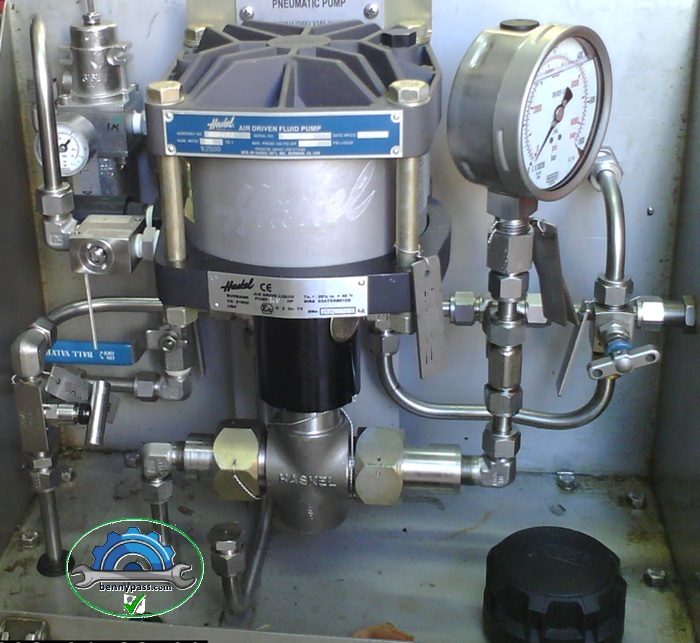
Haskel pumps operate as air-driven, reciprocating positive displacement pumps that use low-pressure compressed air to generate high-pressure liquid or gas, often up to 60,000 psi. A large air piston drives a smaller hydraulic plunger, amplifying pressure via a differential area mechanism, cycling automatically until a stall pressure is reached.
Key Working Principles
- Pneumatic Driving Force: A compressed air supply (1-10 bar) acts on a large area air piston.
- Reciprocating Motion: An unbalanced, non-detented air valve spool alternately pressurizes and vents the air piston, causing it to move back and forth (reciprocate).
- Differential Area Pressure Amplification: The air piston is mechanically connected to a smaller-diameter plunger in the hydraulic section. The ratio of the large air area to the small hydraulic area determines the pressure magnification.
- Check Valve Action: During the suction stroke, the outlet check valve closes and the inlet opens to bring in liquid. During the pumping stroke, the inlet closes and the piston forces the liquid out through the outlet check valve.
- Automatic Stall: The pump operates on demand. It cycles rapidly, then slows as pressure builds. When the output pressure force balances the air drive force, the pump stops (stalls) without needing to be shut down.
Step-by-Step Working Principle
- Air Induction: Compressed air (typically 1–10 bar) enters the air chamber and pushes against the large air piston.
- Pressure Intensification: Because the air piston is mechanically connected to a much smaller hydraulic plunger, the force is concentrated. This results in an output pressure that is a multiple of the input air pressure (defined by the pump ratio).
- Automatic Cycling: As the piston reaches the end of its stroke, a pilot valve shifts the cycling spool, reversing the airflow to the other side of the piston. This causes the pump to reciprocate (move back and forth) automatically.
- Suction and Discharge:
- Suction Stroke: The plunger moves to increase volume in the hydraulic body, opening the inlet check valve to draw in fluid.
- Pumping Stroke: The plunger reverses, closing the inlet valve and forcing the fluid out through the outlet check valve.
- The Stall Feature: The pump will cycle rapidly at first and slow down as downstream pressure builds. It eventually reaches a "stall" point where the force of the air drive exactly balances the resistance of the high-pressure fluid. At this point, the pump stops moving and maintains pressure without consuming further energy.
Key Differences
- Medium & Design: Liquid pumps handle oils, water, or solvents. Gas boosters are designed specifically for gases (nitrogen, hydrogen, etc.) with specialized seals to prevent leakage.
- Compression Mechanism: Liquids are generally incompressible, so liquid pumps use smaller piston areas to generate very high hydraulic pressure. Gas is highly compressible, requiring booster designs that can maximize gas density in each stroke.
- Pressure Ratios: Liquid pumps operate at very high pressures (up to 100,000 psi). Gas boosters, while capable of high pressure, are often designed for lower pressure ratios compared to liquid pumps, focusing on transferring and boosting, sometimes in stages (multi-staging).
- Applications:
- Liquid Pumps: Used for hydrostatic testing, injection molding, and hydraulic clamping.
- Gas Boosters: Used for cylinder charging, gas transfer, and testing with gaseous media.
Summary of Key Features
- Pressure Ratios: Models can reach pressures up to 60,000 psi or even 100,000 psi depending on the specific ratio.
- Safety: Being air-driven, these pumps are inherently safe for hazardous environments as they require no electricity.
- No Heat Generation: Since no power is consumed at stall, the pump does not generate heat while holding pressure.
Key Advantages
- Safety: No electrical hazard, making it ideal for hazardous environments.
- Contamination-Free: Many models are designed to run dry without lubrication.
- Automatic Pressure Control: Maintains pressure without generating heat.
Difference between Haskel liquid pumps and gas boosters
Haskel pumps (liquid pumps and gas boosters) differ mainly in seal design and compression ratios to handle the compressibility of their respective media. Liquid pumps are designed for incompressible fluids, reaching pressures up to 100,000 psi, while gas boosters utilize specialized sealing and multi-staging for compressing gases.
Key Differences at a Glance
| Feature |
Haskel Liquid Pump |
Haskel Gas Booster |
| Media Type |
Liquids (water, oil, chemicals) and liquefied gases. |
Pure industrial gases (nitrogen, oxygen, helium, hydrogen). |
| Common Name |
Air-Driven Liquid Pump. |
Gas Booster or Gas Compressor. |
| Max Pressure |
Up to 100,000 psi (7,000 bar). |
Typically up to 39,000 psi (standard models). |
| Compression |
Moves incompressible fluids; pressure is generated by area ratio. |
Compresses compressible gases; requires cooling and multi-staging for high efficiency. |
| Seals |
Liquid-specific seals (e.g., Viton, EPR) designed for lubrication by the fluid. |
Specialized dry-running or gas-specific seals (e.g., for hydrogen or oxygen service). |
1. Media Handling & Application
- Liquid Pumps: Designed for "hydrostatic" applications like pressure testing (burst/proof testing), chemical injection, and clamping/crimping. They are built to handle the weight and viscosity of fluids.
- Gas Boosters: Used for cylinder charging, accumulator charging, and gas transfer. Because gas generates heat when compressed, boosters are often designed with cooling fins or jackets.
2. Operational Principle
Both devices use a large-area air piston to drive a small-area plunger (the intensification principle).
- Liquid Pumps: Function by drawing in a "gulp" of liquid on the suction stroke and pushing it out under high pressure on the power stroke.
- Gas Boosters: Must account for the compressibility of gas. They often require a "pre-charge" (supply pressure) to function efficiently, whereas liquid pumps can often "lift" or draw liquid from a tank at atmospheric pressure.
3. Safety & Contamination
- Gas Boosters are frequently "oxygen cleaned" to prevent explosions when handling pure oxygen.
- Liquid Pumps can include a distance piece—an extra space between the air drive and the liquid section—to ensure that no drive air (which might contain oil) contaminates the high-pressure fluid being pumped.
4. Shared Benefits
Both types of Haskel equipment are pneumatically driven, meaning they:
- Are safe for use in hazardous/explosive areas (no sparks).
- Will stall automatically once the target pressure is reached and hold it indefinitely without consuming energy or generating heat.
|




