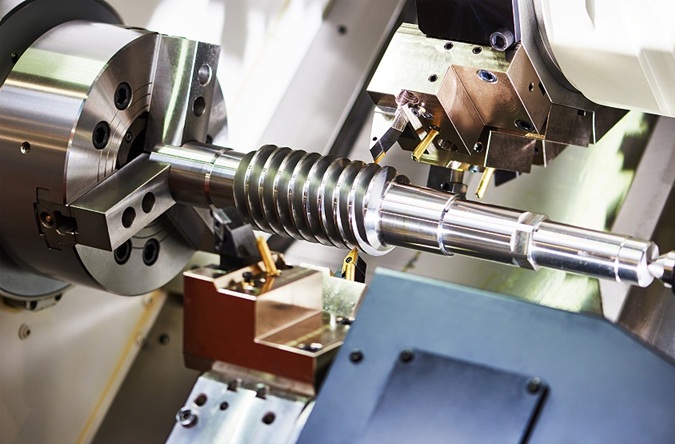
A turning machine (lathe) operates by rotating a workpiece on a spindle while a stationary single-point cutting tool moves linearly, removing material to create cylindrical, conical, or shaped parts. The process, often automated via CNC technology, uses precise control over spindle speed, tool feed rate, and cutting depth to achieve high-precision results.
This video explains the basic working principle of a lathe machine:
Core Working Principle Breakdown
Rotation (Workpiece): The workpiece is clamped in a chuck or collet on the headstock spindle, rotating at a set speed.
Linear Movement (Tool): A single-point cutting tool is mounted on the carriage, which moves longitudinally or transversely relative to the workpiece axis.
Material Removal: The cutting tool engages the surface of the spinning workpiece, removing material in the form of chips to achieve the desired shape and dimensions
Precision and Control: The process uses either manual or automated CNC controls to move the tool precisely along different axes to form various shapes.
Key Components of a Turning Machine
Headstock: Holds and drives the workpiece with a spindle.
Tailstock: Supports the other end of long workpieces.
Carriage/Tool Post: Holds the cutting tool and controls its movement and feed rate.
Bed: A rigid base that supports all other components.
This video provides an overview of the main components of a lathe machine:
Main Types of Turning Operations
Straight Turning: Tool moves parallel to the workpiece axis to create a constant diameter.
Taper Turning: Tool moves at an angle to create tapered or conical features.
Facing: Tool moves across the end of the part, cutting perpendicular to the axis.
Internal Turning (Boring): The tool enters the workpiece, often through an existing hole, to expand or shape the interior, as explained on ZCSMould.
Grooving/Parting: The tool cuts narrow grooves or severs the finished part from the raw stock.
This video demonstrates different types of turning operations:
Key Process Parameters
Cutting Speed: The rate at which the workpiece rotates, affecting finish quality.
Feed Rate: The distance the tool moves per revolution, impacting material removal speed.
Depth of Cut: How deeply the tool penetrates the material.
Have a Questions?
+(39) 347 051 5328
Visit Our Company
Italy - Kazakhstan
Working Hours
09.00am to 18.00pm
About
We offer the best and economical solutions, backed by 27+ years of experience and international standards knowledge, echnological changes, and industrial systems.