|
Open Rack Vaporizers (ORVs) FOR LNG system - Working Principle
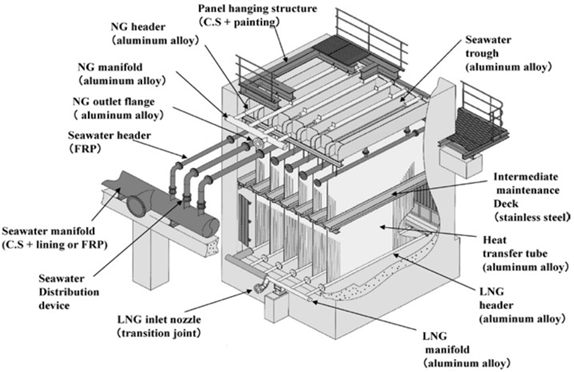
Open Rack Vaporizers (ORVs) use seawater to vaporize Liquid Natural Gas (LNG) at roughly back to gas, acting as an efficient, emission-free, base-load unit. Seawater cascades down the outside of vertically finned heat exchange tubes, while LNG flows upward inside, absorbing heat through convection/conduction to become gaseous natural gas, typically exiting at 5°C to 15°C
Key Components and Functionality
- Vertical Heat Exchangers: Composed of aluminum tubes with external fins to maximize heat transfer area.
- Seawater Distribution System: Seawater at ambient temperature is pumped to the top and flows down over the tubes, often treated with chlorine to prevent marine growth.
- LNG Flow: Cold LNG feeds into the bottom of the tubes, rising as it vaporizes.
- Ice Management: While ice forms on the outside of the tubes due to extreme cold, the design ensures it doesn't inhibit heat transfer.
Key Components & Features
- Heat Transfer Panels: Vertical aluminum tubes are often arranged in "panels" with star-fin shapes to maximize the surface area for heat exchange.
- Corrosion Protection: Tubes are externally coated with a zinc alloy to prevent corrosion from constant exposure to seawater.
- Ice Management: Because the LNG is so cold, ice can form on the outside of the tubes. The design of the seawater film and panel structure helps restrict ice growth to maintain stable heat exchange.
- Low Operating Cost: Since seawater provides "free" heat, ORVs have very low running costs compared to vaporizers that burn fuel for heat.
ORV Working Principle Steps
- Water Supply: Seawater is pumped from the ocean and distributed over the top of the heat exchanger panels.
- Heat Transfer: Seawater flows downward, transferring its sensible heat to the tubes.
- Vaporization: Inside the panels, the -160°C LNG absorbs this heat, changing from a liquid state to a gaseous state.
- Natural Gas Output: Natural gas is collected from the top of the units, while cooled water is collected at the bottom and returned to the sea.
Working Principle
The ORV operates on the principle of direct heat transfer between falling seawater and rising LNG through a network of vertical tubes.
- LNG Flow (Internal): Cryogenic LNG enters the vaporizer through a bottom manifold and flows upward through several vertical aluminum alloy heat exchange tubes.
- Seawater Flow (External): Seawater is pumped to the top of the unit, where it is distributed via a spray system or troughs. It flows downward as a thin film over the outer surface of the vertical tubes.
- Heat Exchange: The relatively warm seawater (ideally above 5°C) transfers its natural heat to the -160°C LNG inside the tubes. This causes the LNG to boil and vaporize into Natural Gas (NG) as it ascends.
- Gas Discharge: The vaporized natural gas, now at a temperature typically between 5°C and 15°C, exits through a top collector manifold and is sent to the transmission pipeline.
- Seawater Collection: The seawater cools slightly as it loses heat to the LNG, falls into a collection basin at the bottom, and is returned to the sea.
Typical Operational Conditions
| Parameter |
Typical Value |
| LNG Inlet Temperature |
Approx. -160°C |
| NG Outlet Temperature |
5°C to 15°C |
| Min. Seawater Temperature |
Above 5°C |
| Capacity |
Can exceed 300 tonnes/h per unit |
Advantages in LNG Systems
- High Efficiency: High heat transfer rates with minimal energy input (only for seawater pumps).
- No Direct Emissions: Utilizing ambient seawater avoids the emissions associated with combustion vaporizers.
- Environmental Control: Often used alongside Submerged Combustion Vaporizers (SCVs) as a backup.
|