|
Key Components of LNG system
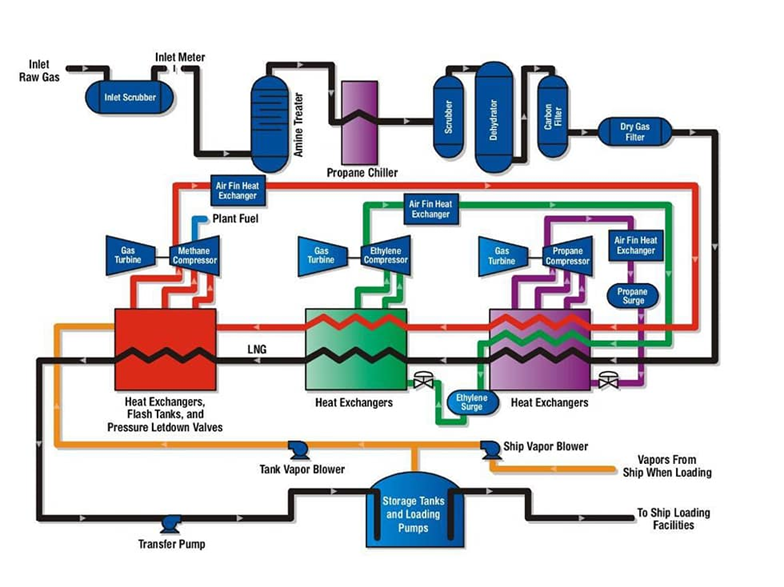
An LNG (Liquefied Natural Gas) system converts natural gas into a cryogenic liquid (approx -162°C) to reduce its volume by 600 times for transport, then regasifies it for use. Key components include pretreatment units (removal CO2, H2O), compression/refrigeration units for cooling, cryogenic storage tanks, and vaporizers (heat exchangers) for regasification.
Key Components of an LNG System
- Pretreatment Unit (Gas Conditioning): Removes contaminants such as water (H2O), carbon dioxide (CO2), hydrogen sulfide (H2S), and mercury to prevent freezing and corrosion in the cryogenic process.
- Liquefaction Unit (LNG Train): The core unit utilizing heavy refrigeration cycles (propane, ethylene) to cool natural gas below -162°C.
- Compressors: Increase the pressure of refrigerants to move heat out of the system.
- Cryogenic Heat Exchangers: Enable rapid cooling of the gas through specialized heat exchange.
- Cryogenic Storage Tanks: Specialized double-walled, insulated tanks (e.g., perlite insulation) designed to store liquefied gas at extremely low temperatures.
- Loading Arms: Specialized articulated arms for safe transfer of cryogenic liquids between ships and onshore storage.
- Regasification Unit (Vaporizers): Heat exchangers that raise the temperature of LNG, transforming it back into a gaseous state (e.g., open rack or submerged combustion vaporizers).
Working Principle
- Treatment: Raw natural gas is purified to remove water, acidic gases, and impurities.
- Liquefaction: The clean gas passes through a series of refrigerants (e.g., propane, ethylene, or mixed refrigerants) in heat exchangers, cooling it to -162°C until it liquefies.
- Storage: LNG is stored in insulated tanks at atmospheric pressure.
- Transportation: The liquid is transported via specialized cryogenic tankers.
- Regasification: At the destination, the LNG is pumped into a vaporizer, where it is heated by seawater or air, expanding 600 times back into a gaseous state for distribution in pipelines.
|




