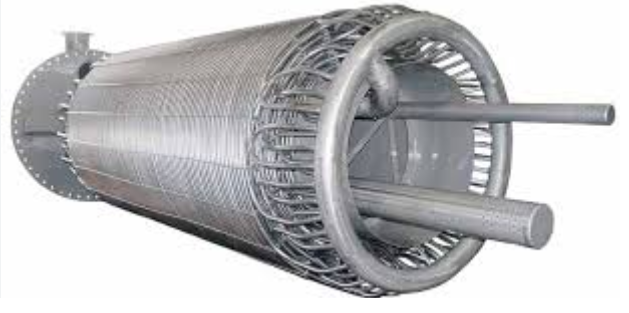
Coil-Wound Heat Exchangers (CWHEs)

coil

 In the LNG industry, Coil-Wound Heat Exchangers (CWHEs)—also known as spiral-wound or spool-wound exchangers—are the "heart" of the liquefaction process. They are specifically designed to cool natural gas from ambient temperatures down to approximately -162°C (-260°F), turning it into a liquid for efficient transport.

Working Principle

The CWHE operates on a cross-counter flow heat exchange principle:
  • Tube-Side (The Warm Stream): High-pressure natural gas (feed gas) flows through thousands of small-diameter tubes. These tubes are helically wound in multiple layers around a central vertical core, called a mandrel.
  • Shell-Side (The Cold Stream): A cold refrigerant (often a mixed refrigerant) is sprayed or distributed at the top of the unit. It flows downward over the outside of the tube bundles.
  • Heat Transfer: As the warm gas moves upward (or through the tubes) and the cold refrigerant flows downward across them, heat is transferred from the gas to the refrigerant. This causes the natural gas to cool, condense, and eventually subcool into LNG.

Key Components & Design Features

  • The Mandrel: A large central pipe that acts as the structural "spine" around which the tube layers are wound.
  • Helical Tube Bundles: Hundreds of miles of tubing are wound like a giant spring. This "spring-like" geometry allows the bundle to expand or shrink freely during extreme temperature changes (start-up or shut-down) without mechanical failure.
  • Outer Shell: A massive pressure vessel that encloses the entire tube bundle and contains the shell-side refrigerant.
  • Multi-Stream Capability: A single CWHE can handle multiple different fluid streams (e.g., cooling the feed gas while simultaneously cooling various refrigerant components) within the same shell.

Why They are Used in LNG

CWHEs are preferred for large-scale "baseload" LNG plants for several reasons:
  • Robustness: They handle the severe temperature gradients (from ambient to -162°C) better than almost any other exchanger type.
  • High Efficiency: They offer a very large heat transfer surface area in a relatively compact footprint.
  • High Pressure: They can safely manage the high-pressure gas streams required for efficient liquefaction, sometimes exceeding 200 bar.

favicon bacd

+(39) 347 051 5328

Italy - Kazakhstan

09.00am to 18.00pm

About

We offer the best and economical solutions, backed by 27+ years of experience and international standards knowledge, echnological changes, and industrial systems.

Marketing Materials

Spring Renovation
Industry
US Gas Company
Construct
Plus Project
Vam Drilling Service
X Project
X Project
Cabrrus Training

Marketing Materials1

Spring Renovation
Industry
US Gas Company
Construct
Plus Project
Vam Drilling Service
ultrasonic sensor
ultrasonic sensor
Cabrrus Training