
|
Intermediate Fluid Vaporizer (IFV) of LNG system - Working Principle
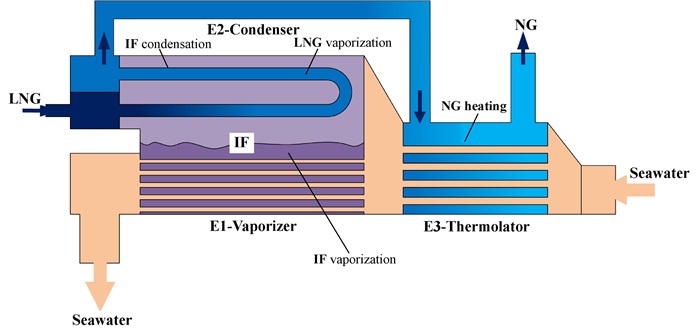
An Intermediate Fluid Vaporizer (IFV) in an LNG system uses a secondary heat transfer fluid (usually propane) to indirectly vaporize LNG, preventing seawater freezing. It operates via three stages—evaporation of propane by seawater, condensation of propane by LNG, and gas heating—to efficiently regasify LNG into gaseous natural gas at ambient temperatures. Working Principle & Components The IFV is typically a shell-and-tube heat exchanger developed by Osaka Gas. It utilizes an intermediate fluid (e.g., propane, freon) to transfer heat from a warm source (seawater) to the cold LNG ( -163°C), which prevents the seawater from freezing on the heat exchanger surfaces. Stage 1: Evaporator (E-1) - Intermediate Fluid Vaporization
Stage 2: Condenser (E-2) - LNG Vaporization
Stage 3: Heater (E-3) - Natural Gas Heating
Key Features and Advantages
Intermediate Fluids Used Commonly used intermediates include propane or dimethylether, chosen for their low boiling points, allowing them to boil at low temperatures while condensing at slightly higher temperatures. |

+(39) 347 051 5328
Italy - Kazakhstan


09.00am to 18.00pm
About
We offer the best and economical solutions, backed by 27+ years of experience and international standards knowledge, echnological changes, and industrial systems.
Our Services
Marketing Materials


Marketing Materials1


