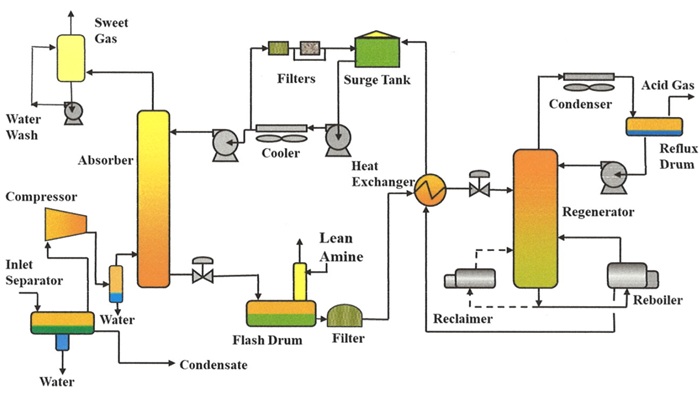
An amine treating system, or gas sweetening unit, removes H2S and CO2 from sour gas by circulating an aqueous amine solution in a continuous absorption-regeneration loop. The process absorbs acid gases into the solvent (lean-to-rich) in a contactor, followed by thermal regeneration (rich-to-lean) to release the impurities and reuse the amine, effectively creating a closed-loop system.
This video provides an overview of how an amine scrubbing system works:
Core Working Principles
The system operates through two primary steps:
Absorption (Contactor/Absorber): Sour gas enters the bottom of a contactor column, while "lean" (clean) amine solution is fed into the top. As the gas rises, it flows upward through trays or packing, making intimate contact with the downward-flowing amine. The amine chemically absorbs the H2S and CO2 and "sweet" (treated) gas exits the top.
Regeneration (Stripper/Regenerator): The "rich" amine (containing the absorbed acid gases) is sent to a regenerator column. It is heated (typically to 225°F or 105 - 125°C) in a reboiler, breaking the chemical bonds and releasing the H2S and CO2 as top gas, which are then sent to a sulfur recovery unit or flare. The regenerated "lean" amine is cooled and pumped back to the absorber.
Key Components of an Amine System
Inlet Separator: Removes solids and liquids (hydrocarbons/water) from the sour gas to prevent foaming.
Absorber (Contactor): A trayed or packed tower where the absorption process occurs.
Regenerator (Stripper): A tower where heat reverses the absorption process.
Reboiler: Provides the heat to strip acid gases from the rich amine.
Heat Exchangers & Pump: Cools the lean amine and pumps it back into the absorber.
Common Amines Used
The choice of amine depends on the feed gas composition and desired purity:
MEA (Monoethanolamine): High reactivity, often used for total acid gas removal.
DEA (Diethanolamine): Often used in gas plants.
MDEA (Methyldiethanolamine): High selectivity for H2S over CO2
Why It Is Used
Safety: H2S is highly toxic and lethal even at low concentrations.
Corrosion Prevention: Acid gases in the presence of water form acids that can corrode pipelines and equipment.
Efficiency: The closed-loop design minimizes chemical waste and operational costs.
The Process Cycle
The system is a closed-loop process consisting of two primary stages:
1. Absorber (Contactor) Stage
Inlet: Sour gas enters at the bottom, and "Lean Amine" (clean solvent) is sprayed from the top.
Contact: As they pass each other over trays or packing, the amine absorbs the and H2S and CO2
Outlet: Purified "Sweet Gas" exits the top, while "Rich Amine" (loaded with acid gas) collects at the bottom.
2. Stripping (Regenerator) Stage
Pre-heating: The rich amine passes through a heat exchanger to gain heat from the hot lean amine returning from the regenerator.
Stripping: In the regenerator column, a reboiler heats the solution, creating steam that "strips" the acid gases out of the amine.
Cooling: The now-lean amine is cooled and pumped back to the absorber to start the cycle again.
This technique is essential in natural gas processing, refineries, and petrochemical plants to prepare gas for sale or to prevent atmospheric pollution.
Have a Questions?
+(39) 347 051 5328
Visit Our Company
Italy - Kazakhstan
Working Hours
09.00am to 18.00pm
About
We offer the best and economical solutions, backed by 27+ years of experience and international standards knowledge, echnological changes, and industrial systems.