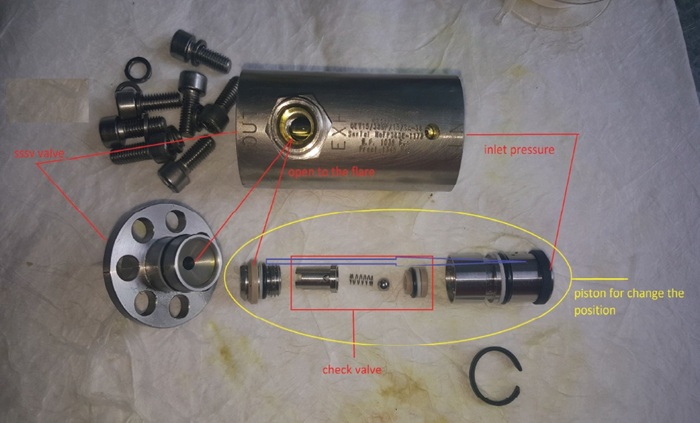
Quick exhaust valve - Working Principle

quick12

A hydraulic quick exhaust valve accelerates cylinder movement by venting fluid directly at the actuator, bypassing long return paths to the main control valve. It uses a pressure-sensitive poppet: inlet pressure seals the exhaust port to fill the cylinder, while a drop in pressure unseats the poppet, allowing rapid dumping of fluid.

This video provides a visual explanation of how a quick exhaust valve works:

Working Principle 

 The valve operates based on pressure differentials acting on an internal moving part, typically a poppet or diaphragm. It has three ports: Inlet (from the control valve), Outlet (to the cylinder), and Exhaust (to the tank).

  1. Pressurization Phase (Filling the Actuator):
    • When pressurized hydraulic fluid enters the Inlet port, it pushes the internal poppet against the Exhaust port, sealing it shut.
    • The fluid then flows around the poppet and through the Outlet port into the cylinder, extending or retracting the actuator.
  2. Exhaust Phase (Rapid Actuation):
    • When the control valve shifts to "exhaust" or supply pressure is removed, the pressure at the Inlet port drops.
    • High-pressure fluid trapped in the cylinder (at the Outlet port) creates a back-pressure that shifts the poppet in the opposite direction.
    • This movement blocks the Inlet and opens a direct, wide-bore path from the Outlet to the Exhaust port.
    • The fluid vents immediately, drastically reducing backpressure and allowing the actuator to move at much higher speeds.
Key Benefits
  • Increased Speed: Actuator cycle times can be improved by up to 50% because the fluid doesn't have to travel back through restricted control valve passages.
  • Reduced Backpressure: By venting at the point of use, it prevents pressure buildup that would otherwise resist the actuator's motion.
  • Thermal Protection: In some hydraulic versions, an internal orifice allows for small amounts of flow to bypass the poppet, relieving pressure caused by thermal expansion of the fluid within the actuator.
Typical Applications
  • Surface Safety Valves (SSVs): Ensuring rapid closure in emergency shutdown scenarios.
  • Fast-Cycling Machinery: Used in high-speed manufacturing where quick resets are critical for productivity.
  • Remote Actuators: Ideal for systems with long distances between the control station and the cylinder.

favicon bacd

+(39) 347 051 5328

Italy - Kazakhstan

09.00am to 18.00pm

About

We offer the best and economical solutions, backed by 27+ years of experience and international standards knowledge, echnological changes, and industrial systems.

Marketing Materials

Spring Renovation
Industry
US Gas Company
Construct
Plus Project
Vam Drilling Service
X Project
X Project
Cabrrus Training

Marketing Materials1

Spring Renovation
Industry
US Gas Company
Construct
Plus Project
Vam Drilling Service
ultrasonic sensor
ultrasonic sensor
Cabrrus Training