
Stud Bolt – A Complete Guide of Pipe FastenersStud bolts, nuts, machine bolts and washers are also known as bolting materials or fasteners. Bolting is the term used to tighten/create the flange joint connection. Tightening of the flange ensures a leak-proof connection between the gasket & flanges. ASME flanges have a minimum of four bolt holes and for higher diameter flanges, the number of bolt holes is always in multiples of four. The number selection of the bolt holes depends on the factor such as
Different Kinds of Fasteners Used in Piping
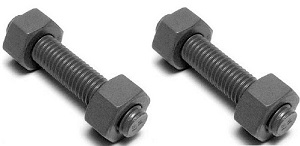
Stud BoltStud has a thread on full lengths or at both ends. As shown in images. It is having three components if washers are not used (two nuts and stud). If you used washer it would become five. Sometimes additional nuts are used for hydraulic tensioning with larger size stud.
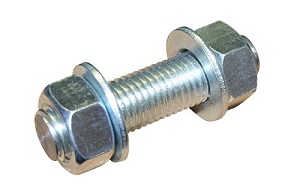
The length of stud bolt should be enough to cover entire Nut plus 1.5 to 3 threads exposed. Long studs must be avoided as it increases the chance of corrosion and other damage to exposed threads, which would make subsequent removal difficult. ASME B16.5 gives the required size of the stud. Length of the stud depends on the type of gasket and the maximum exposed thread requirements. Machine BoltBolts have a thread at one end and hexagonal head on another end. See the image below. In the process, piping bolts are used with lower strength flange types such as GRE/GRP, bronze. Usually, washers are used with bolt to prevent excessive load to the flange.
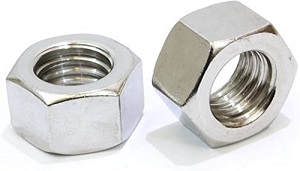
NutsCommonly Hexagonal Heavy-series nuts used with studs. The nonbearing face of a nut is chamfered, while load Bearing face is finished with a washer face or may be chamfered.
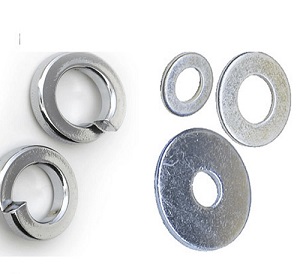
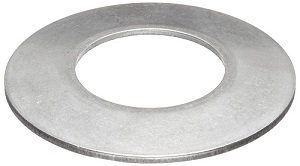
WashersA washer is a thin plate with a hole at center. Washers distribute the load on flange face; this prevents damage to the flange. Non-metallic flange required washers due to this reason. Different types of washers are used such as Flat, Splits, and Conical Springs. Flat and split washers are shown in the image.
Conical washers are special washers. Also known as Belleville Springs washers. It Keeps bolted joints tight in an area where vibration, differential thermal expansion, and bolt creep present. These conditions can change the load on a stud which may result in a loose connection. Conical washers provide a spring effect and prevent loosening of a stud. This washer provides High spring loads with small deflections.
Stud Bolt Specification & StandardVarious ASME standards are used for stud bolts and nuts to manufacturing bolting material. List of such standard is given below.
Stud Material GradesBolting material can be divided into three group
StudList of ASTM Material grade used for manufacturing stud is given in ASME B16.5, which is the Standard for the flanges.
Out of these grades, most popular material grades are ASTM A193 Gr B7 & B7M.
NutsNuts may be machined from the same material as stud or may be of a compatible grade of ASTM A194
WasherCommon material grade used for washer manufacturing are
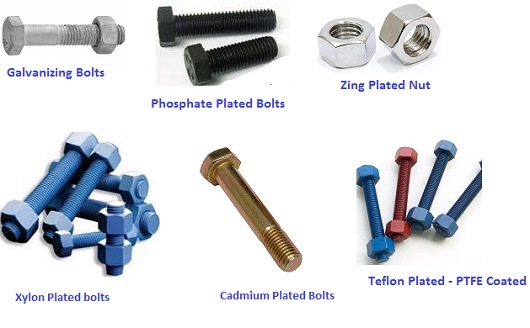
Coating on Stud Bolts and NutsSometimes Bolting components are coated with different coating materials to improve its corrosion resistance. This will reduce maintenance cost. Common coatings are
See coating bolts in the image below.
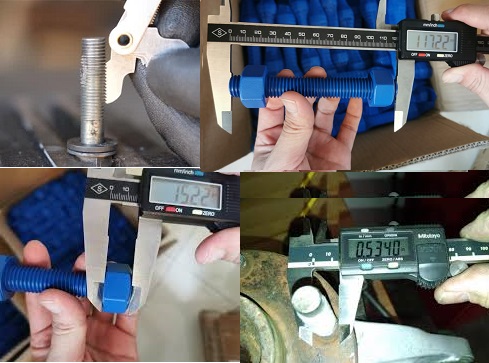
Inspection of stud boltsDuring visual inspection, Check for any surface defect and overall product quality
Following to be confirmed during dimension inspection of the stud bolts
See Photo Below:
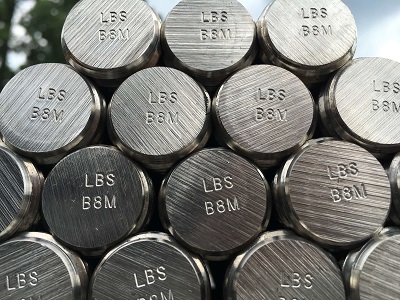
Stud MarkingASTM material Standard A193 and A320 specify marking requirements for stud & bolt. Marking to be done at the ends of the stud or on the bolt head. Due to limited space only, Manufacturer’s identification mark & Material Grade / Class are marked on stud and bolt.
ASTM standard gives the list of marking symbol for various material grades. Check the image below ASTM A193 Gr B7M just marked as B7 at one end and Manufacturer’s identification mark on other ends. In the case of hex head bolt, both the symbols are marked on the bolt head. Nut MarkingASTM material Standard A194 and A563 specify marking requirements for nuts. Marking to be done on the nut’s non-load bearing face. Only Manufacturer’s identification mark and Material Grade / Class are marked. Instead of full material description material symbol is used as shown above. The list of symbols is given in ASTM standard.
What is Hot Bolting?The removal of flange bolts on the live line and equipment that means when plant is running is known as a hot bolting. There are may reasons for hot bolting such a
Hot bolting is hazardous activity and utmost care is necessary while performing the same.
Difference between Stud and Bolts Stud: A fastener with no head and only has threads on both ends. When connecting, one end must be screwed into the part with the internally threaded hole, the other end is passed through the part with the through-hole, and then the nut is screwed, even if the two parts are fastened together as a whole. This type of connection is called a stud connection and is also a detachable connection. It is mainly used for the case where one of the connected parts has a large thickness, requires a compact structure, or is not suitable for bolting due to frequent disassembly. It is recommended where high vibrations are present Bolt: Mechanical parts, cylindrical threaded fasteners with nuts. A type of fastener consisting of a head and a screw (a cylinder with an external thread) is required to be fitted with a nut for fastening the two parts through holes. This type of connection is called a bolted connection. If the nut is unscrewed from the bolt, it is possible to separate the two parts so the bolt connection is a detachable connection. This type of connection is suitable for lifting loads, and it is unkempt where high vibrations are present. |

+(39) 347 051 5328
Italy - Kazakhstan


09.00am to 18.00pm
About
We offer the best and economical solutions, backed by 27+ years of experience and international standards knowledge, echnological changes, and industrial systems.
Our Services
Marketing Materials


Marketing Materials1


