
|
Types of Gate Valve and Parts – A Complete Guide for Engineer What is Gate Valve? A gate valve can be defined as a type of valve that used a gate or wedge type disk and the disk moves perpendicular to flow to start or stop the fluid flow in piping. A gate valve is the most common type of valve that used in any process plant. It is a linear motion valve used to start or stop fluid flow. In service, these valves are either in fully open or fully closed position. When the gate valve is fully open, the disk of a gate valve is completely removed from the flow. Therefore virtually no resistance to flow. Due to this very little pressure drops when fluid passes through a gate valve. To achieve proper sealing, when the valve is fully closed, 360° surface contact is required between the disk and seats. Gate valves should not be used for regulation or throttling of flow because accurate control is not possible. The high velocity of the flow in the partially open valve may cause erosion of the disc and seating surfaces and also create vibration and noise.
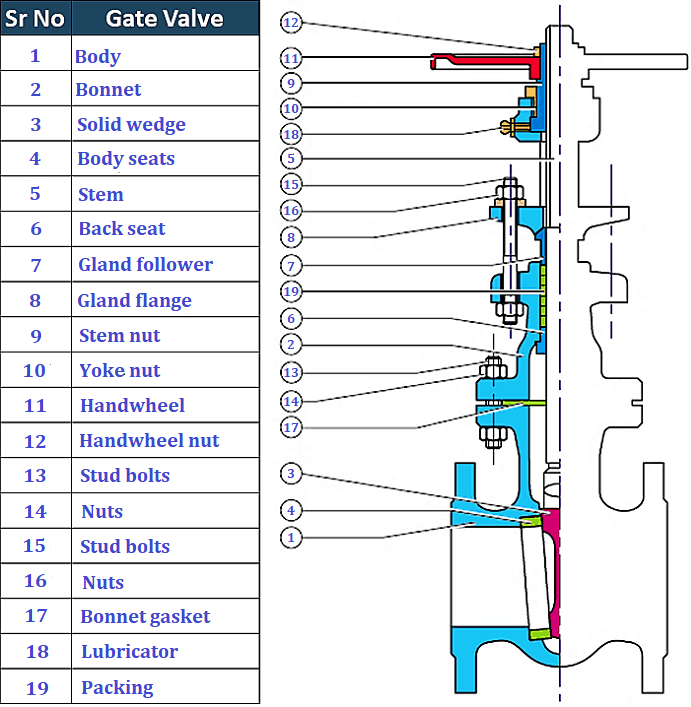
Gate Valve Parts
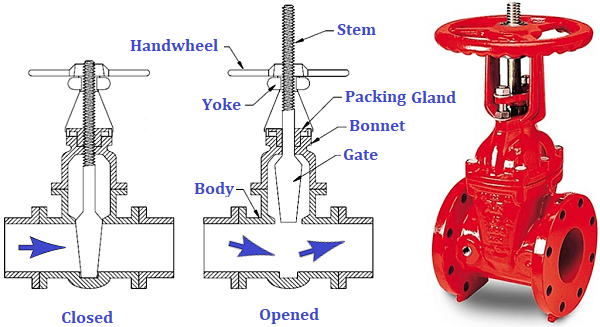
Here you can see the main parts of the gate valve. The disk of a gate valve is also known as a wedge. To learn about each of these parts read the complete guide of valve parts.
Types of Gate Valves There are three ways to classify the gate valve.
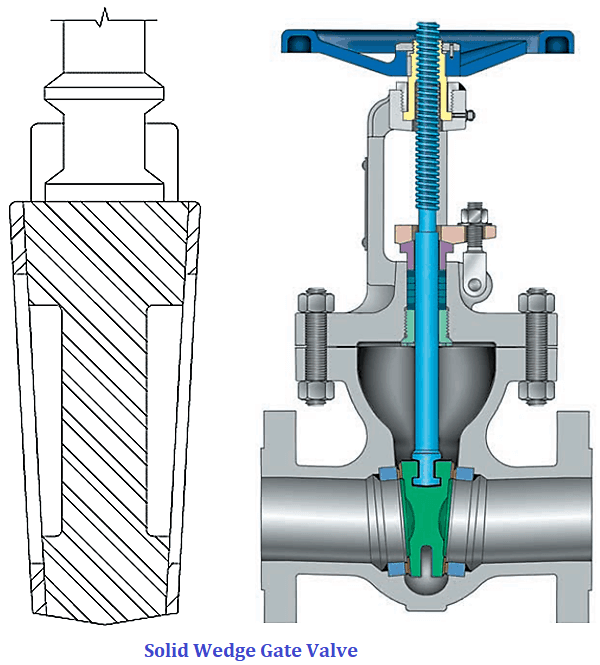
Solid Wedge Gate Valve
Solid wedge is the most common & widely used disk type because of its simplicity and strength. A valve with a solid wedge may be installed in any position, and it is suitable for almost all fluids. It can be used in turbulent flow also. However, it does not compensate for changes in seat alignment due to pipe loads or thermal expansion. So, this type of disk design is most susceptible to leakage. A solid wedge is subjected to thermal locking if used in high-temperature service. Thermal locking is a phenomenon in which wedge is stuck between the seats due to the expansion of the metal. Solid-wedge gate valves are generally used in moderate to lower pressure-temperature applications.
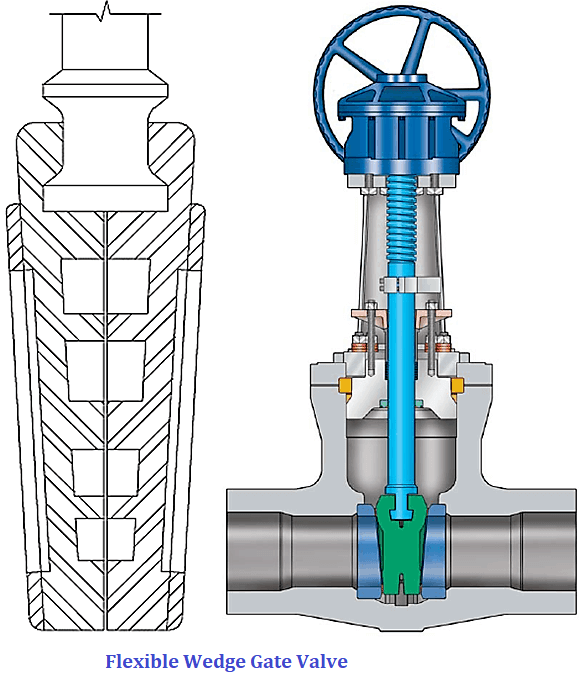
Flexible Wedge Gate Valve The flexible wedge is a one-piece solid disk with a cut around the perimeter. These cuts vary in size, shape, and depth. A shallow, narrow cut on wedge perimeter gives less flexibility but retains strength. A cast-in recess or deeper and wider cut on wedge perimeter gives more flexibility but compromises the strength. This design improves seat alignment and offers better leak tightness. It also improved performance in situations where thermal binding possible. Flexible wedges Gate valves are used in steam systems. Thermal expansion of steam line sometime causes distortion of valve bodies which may lead to thermal blinding. The flexible gate allows the gate to flex as the valve seat compresses due to thermal expansion of steam pipeline and prevent thermal blinding. The disadvantage of flexible gates is that line fluid tends to collect in the disk. These may result in corrosion and ultimately weaken the disk.
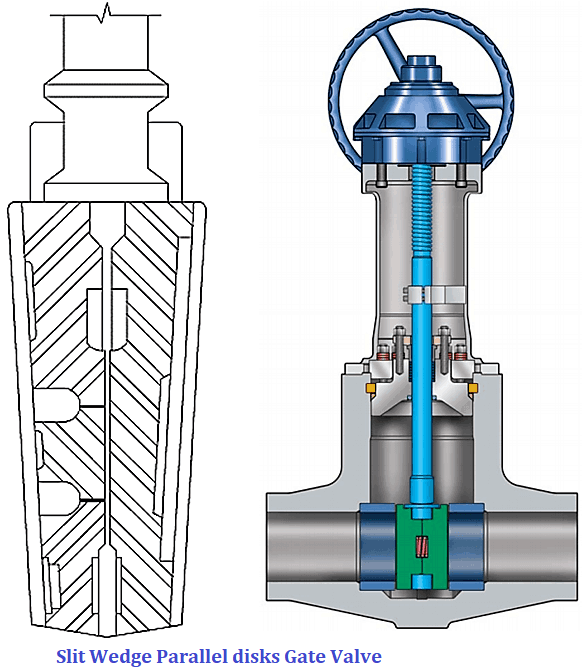
Split wedge or Parallel disks Gate Valve Split wedge Disk consists of two solid pieces and holds together with the help of special mechanism. You can see the same in images. In case, one-half of the disk is out of alignment; the disk is free to adjust itself to the seating surface. The split disk can be in a wedge shape or a parallel disk type. Parallel disks are spring loaded, so they are always in contact with seats and give bi-directional sealing. Split wedge is suitable for handling noncondensing gasses and liquids at normal and high temperature. Freedom of movement of the disk prevents thermal binding even though the valve may have been closed when a line is cold. This means when a line is get heated by fluid and expand it does not create thermal blinding.
Types of gate valve based on body, bonnet connection
1st is screwed bonnet: This is the simplest design available and it is used for inexpensive valves. 2nd is bolted-bonnet: This is the most popular design and used in a large number of gate valves. This requires a gasket to seal the joint between the body and bonnet. 3rd is Welded-Bonnet: This is a popular design where disassembly is not required. They are lighter in weight than their bolted-bonnet counterparts. 4th one is Pressure-Seal Bonnet: This type is used extensively for high-pressure high-temperature applications. The higher the body cavity pressure, the greater the force on the gasket in a pressure -seal valve.
OS & Y Gate Valve or Rising Stem (Outside Stem and Screw Type)
For a rising stem valve, the stem will go up while opening the valve and move down when you close the valve. You can see in the image. In inside screw design, the threaded portion of the stem is in contact with the flow medium and when you open the valve, handwheel rise with the stem. Whereas in the case of outside screw design, the only smooth portion is exposed to the flow medium and stem will rise above the handwheel. This type of valve is also known as OS & Y valve. OS & Y means outside steam and York.
Non-rising Stem Gate Valve or Insider Screw Valve
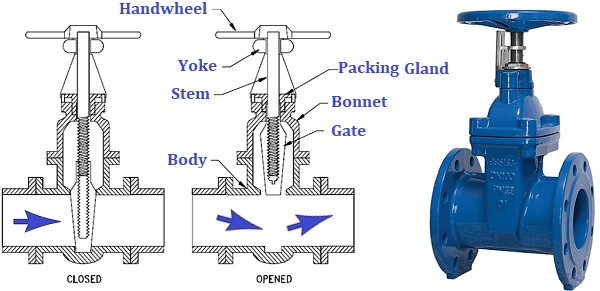
There is no upward movement of the stem in a non-rising stem type. The valve disk is threaded internally. The disc travels along the stem like a nut when the stem is rotated. You can see the image. In this type of valve, stem threads are exposed to the flow medium. Therefore, this design is used where space is limited to allow linear stem movement, and the flow medium does not cause erosion, corrosion, or wear and tear to stem material. This type of valve also known as insider screw valve.
Gate Valve Applications
Advantages of Gate Valve
Disadvantage of Gate Valve
|
|
|


+(39) 347 051 5328
Italy - Kazakhstan


09.00am to 18.00pm
About
We offer the best and economical solutions, backed by 27+ years of experience and international standards knowledge, echnological changes, and industrial systems.
Our Services
Marketing Materials


Marketing Materials1


