
What is a Check Valve?
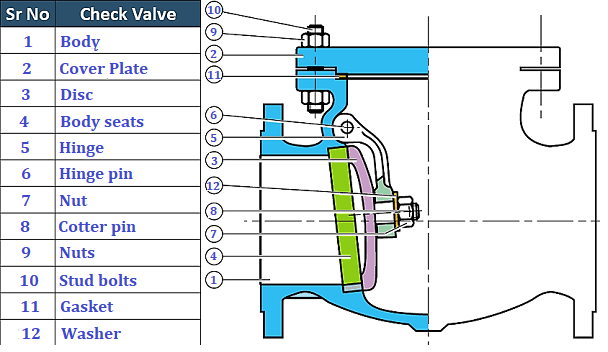
Learn about Check Valves Types and PartsThe valve that is used to prevent backflow in a piping system is known as a check valve. It is also known as a non-return valve or NRV. The pressure of the fluid passing through a pipeline opens the valve, while any reversal of flow will close the valve. It allows full unobstructed flow and automatically shuts as pressure decreases. The exact operation will vary depending on the mechanism of the valve. Check Valve Parts It is consist of a body, cover, disk, hinge pin and seat ring. Figure 1 below shows the parts of the valve.
Types of the Check Valve The type of disk will decide the type of the valve. The most common types of Check valves are
Swing Check Valve
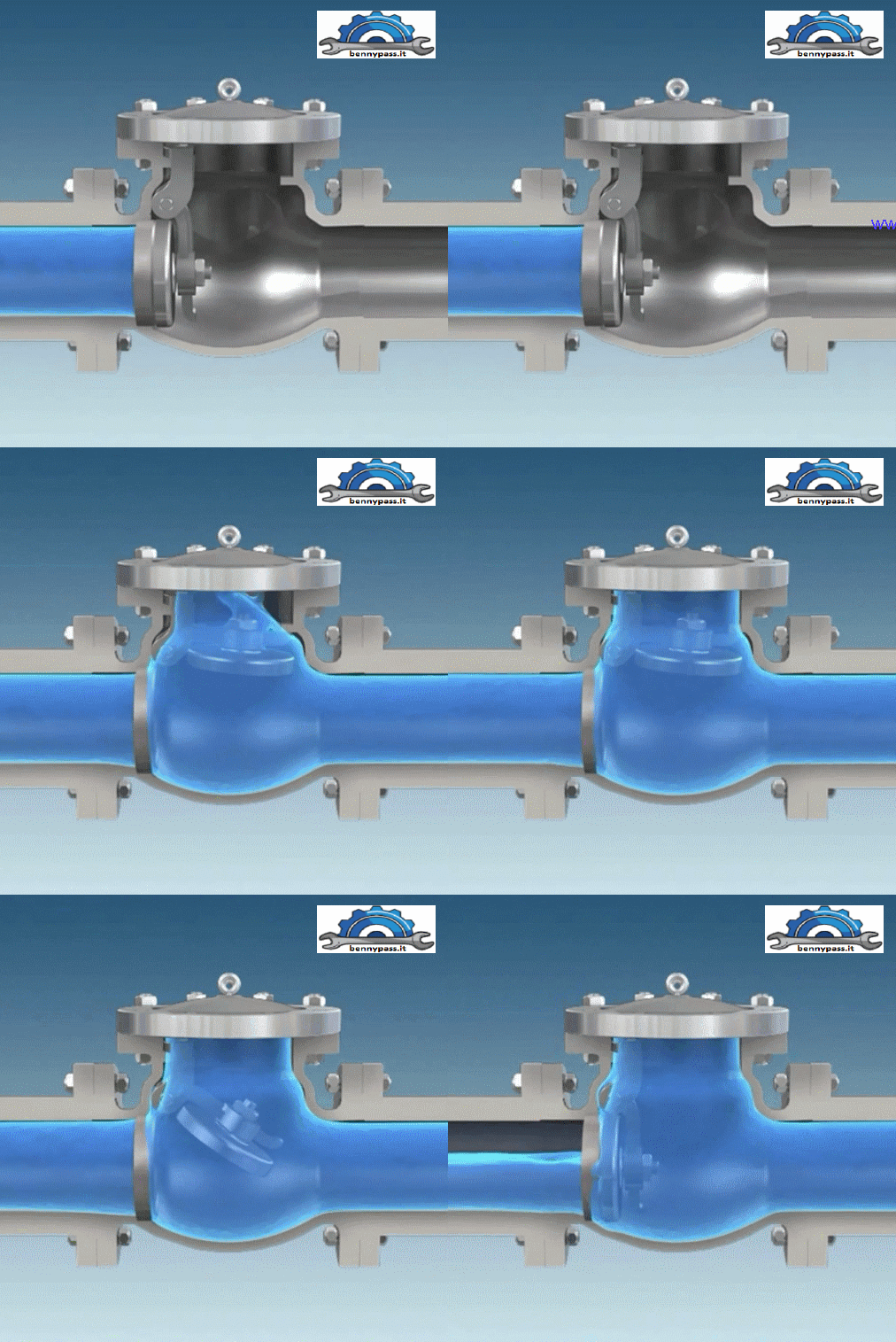
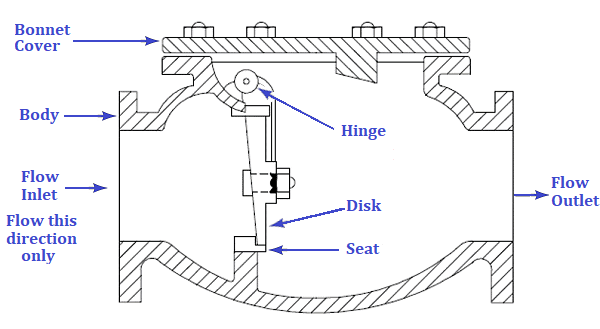
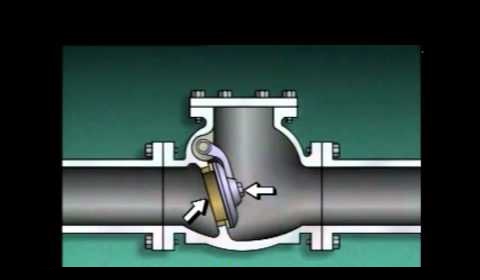
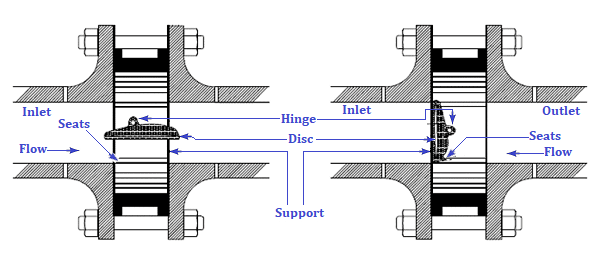
The disc in a swing type valve is unguided as it fully opens or closes. This Valve operates when there is flow in the line and get fully closed when there is no flow. Turbulence and pressure drop in the valve is very low. Disk and seat designs can be of metal to metal or metal to composite. The angle between the seat and the vertical plane is known as the seating angle and vary from 0 to 45 degrees. Usually, the seat angles are in the range of 5 to 7 degrees. Larger seat angles reduce the disc travel, resulting in quick closing, thus minimizing the possibility of a water hammer. A vertical seat has a 0-degree angle. The swing check valve allows full, unobstructed flow and automatically closes as pressure decreases. Usually installed in combination with gate valves because they provide a relatively free flow combination. A basic swing check valve consists of a valve body, a bonnet, and a disk that is connected to a hinge.
Tilting Disc Check Valve
The tilting disc check valve is designed to overcome some of the weaknesses of conventional swing check valves. The design of the tilting disk enables the valve to open fully and remain steady at lower flow rates and close quickly when the forwarding flow stop. The dome-shaped disc floats in the flow and fluid flow on both the bottom and top of disk surfaces. As the disk is spring-loaded, when forward flow pressure reduces, the spring force helps the valve to close fast. In the image above, you can see the flow from the valve. Tilting Disc Check Valve are available in wafer type and lug type design.
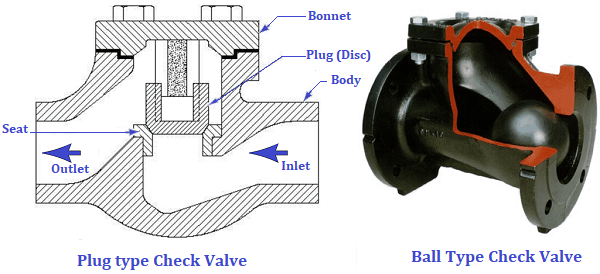
Ball Type and Plug Type Lift Check Valve The seat design of a lift Check valve is similar to a Globe valve. A piston or a ball is usually used as a disk. Lift Check valves are particularly suitable for high-pressure service where the velocity of flow is high. The disk is perfectly set on the seat with full contact. They are suitable for installation in horizontal or vertical pipelines with upward flow. When the flow enters below the seat, a disk is raised from the seat by the pressure of the upward flow. When the flow stops or reverses, the backflow and gravity forced the disk downward to set on the seat. Commonly used in piping systems that used globe valves as a flow control valve.
Here you can see the plug or piston type and ball type check valve. These valves provide superior leak-tight characteristics to those of swing check valves. Some design in plug type uses spring to retain the disk in the closed position. This will ensure that valve allows flow only when there is enough pressure in the flow direction. The ball-type valve is very simple as it simply works on the principle of gravity. When there is enough pressure in the flow, it lifts the ball upward but when pressure is reduced ball roll down and closed the opening.
Dual Plate / Dual Disc Check Valve
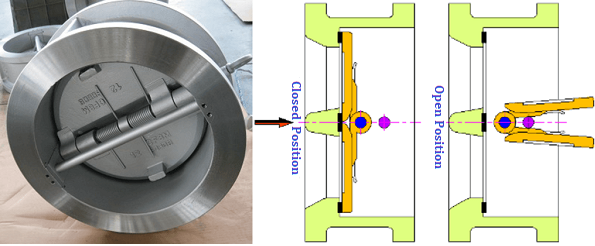
Figure 6 A dual plate check valve is known as a butterfly check valve, Folding Disc Check Valves, double-disc or split disc check valve. As the name suggests, two halves of the disk move towards the centreline with the forward flow and with reverse flow two halves open and rest on the seat to close the flow (Flapping action). Use of Dual Plate Check Valve is popular in low-pressure liquid and gaseous services. Its lightweight and compact construction make it a preferable choice when space and convenience are important. It is 80 to 90% lighter than a conventional full body check valve. Frequently used in systems that used butterfly valves. The cost of installation & maintenance is very low compared to other types.
Stop Check Valve
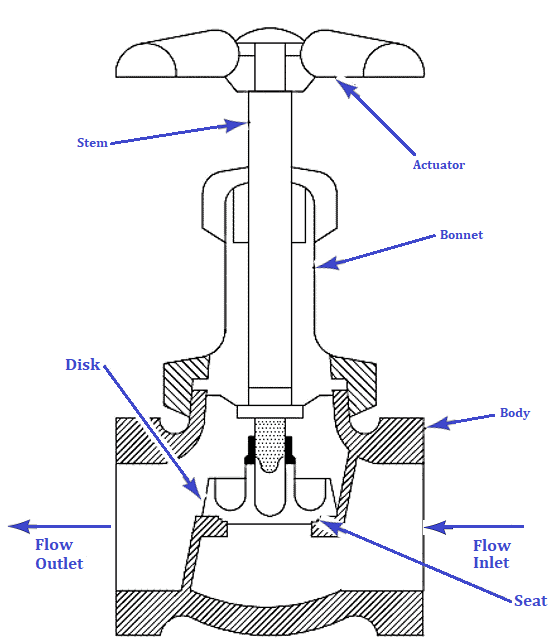
Stop Check Valve is a combination of a lift check valve and a globe valve. It can either be used as a check valve or as an isolation (stop) valve like a globe valve. These valves can be closed with the help of a stem that is not connected to the valve disc during normal operation and make it possible to use these valves as a regular check valve. However, when needed, the stem is used to hold the free-floating disc against the valve seat, just as a globe valve. These valves are available in tee, wye, and angle patterns. Swing type and piston lift type check valves are commonly used as stop check valves.
Application of Check Valve (NRV) Check valves (Non-return valves) are used in a piping system to prevent backflow. Discharge line of rotary equipment such as pump and compressor always fitted with a check valve to prevent backflow.
Advantages & Disadvantages Can you guess why I have not mentioned any advantage or disadvantage of the check valve? The only function of a Non-return valve is to prevent backflow. There is no better alternative. Yes, you can choose the best check valve from the various available type that you have learned but you cannot supplement the check valve with another valve.
|
|
|


+(39) 347 051 5328
Italy - Kazakhstan


09.00am to 18.00pm
About
We offer the best and economical solutions, backed by 27+ years of experience and international standards knowledge, echnological changes, and industrial systems.
Our Services
Marketing Materials


Marketing Materials1


